Respiratory

Respiratory

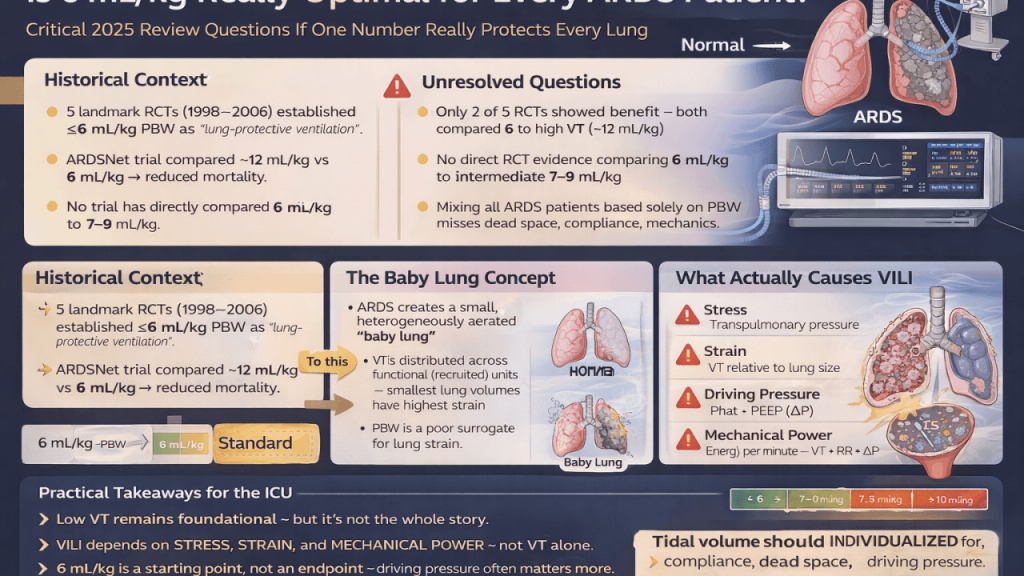
Lung-protective ventilation strategy in acute respiratory distress syndrome: a critical reappraisal of current practice

Why This Article Matters For more than 20 years, lung-protective ventilation has been synonymous with a single number: 6 mL/kg predicted body weight (PBW). This target has been taught, audited, benchmarked, and enforced across ICUs worldwide. Yet despite near-universal endorsement, real-world adherence remains inconsistent—and outcomes have plateaued. This 2025 review asks an uncomfortable but necessary […]

, , ,

Lung-protective ventilation strategy in acute respiratory distress syndrome: a critical reappraisal of current practice Read Post »

Mechanical Ventilation, Respiratory

Invasive ventilator exhaust in critical care: aerosol transmission risks and management strategies-a narrative review

1. Why This Article Matters Invasive mechanical ventilation is the cornerstone of critical care. Yet, one major risk remains overlooked in daily practice: Ventilator exhaust can carry infectious aerosols, biofilm fragments, volatile anesthetics, and VOCs into the ICU environment — posing real risks for patients and staff. This review synthesizes decades of microbiology, aerosol physics,

, ,

Invasive ventilator exhaust in critical care: aerosol transmission risks and management strategies-a narrative review Read Post »

Respiratory

Patient-specific prediction of regional lung mechanics in patients with ARDS with physics-based models: a validation study

1. Why This Study Matters — Why You Should Read This Physiology at the bedside is often guesswork. We titrate PEEP. We adjust driving pressure. We interpret compliance as a global signal, even though ARDS is intensely regional. But imagine if we had a patient-specific digital model — a “virtual twin” — that could simulate

Patient-specific prediction of regional lung mechanics in patients with ARDS with physics-based models: a validation study Read Post »

Respiratory

Balancing the Scales: Using Ventilator Time to Counter Mass Loading

Why This Study Matters — Why You Should Read This Obesity. Abdominal compartment syndrome. Massive chest wall load. We see these patients every day. We crank up PEEP, perform recruitment maneuvers, increase pressures…and yet the lung refuses to open. So what if the problem isn’t pressure at all? What if the missing variable is time?

, ,

Balancing the Scales: Using Ventilator Time to Counter Mass Loading Read Post »

Respiratory

The impact of PEEP-guided electrical impedance tomography on oxygenation and respiratory mechanics in moderate-to-severe ARDS: a randomized…..

Why this study deserves your click Every ARDS patient forces us to answer the same question: “How much PEEP is enough—and how much is too much?” We usually lean on ARDSNet tables, “PEEP ladders,” or our own bias. This trial asks a different question: What happens if we let the lung tell us the right

, ,

The impact of PEEP-guided electrical impedance tomography on oxygenation and respiratory mechanics in moderate-to-severe ARDS: a randomized….. Read Post »

Respiratory

Peri-intubation Cardiovascular Collapse During Emergency Airway Management

Summary This comprehensive review explores why emergency airway management remains one of the most dangerous procedures in critical care medicine. Despite decades of improvement in first-pass success, the physiologic burden of induction and immediate transition to positive-pressure ventilation continues to precipitate hypotension, shock, and cardiac arrest in a large proportion of critically ill patients. The

,

Peri-intubation Cardiovascular Collapse During Emergency Airway Management Read Post »

Respiratory

Continuous non-invasive measurement of tidal volume and minute ventilation using a smart nasal cannula

Abstract This study evaluated whether a newly developed smart nasal cannula can accurately and continuously measure tidal volume (VT) and minute ventilation (VE) in adults across a wide range of respiratory patterns using a validated benchtop model. The device uses nasal pressure and flow dynamics, derived from RPD (respiratory pressure difference) sensors, to estimate VT

, , ,

Continuous non-invasive measurement of tidal volume and minute ventilation using a smart nasal cannula Read Post »

Circulatory, Respiratory

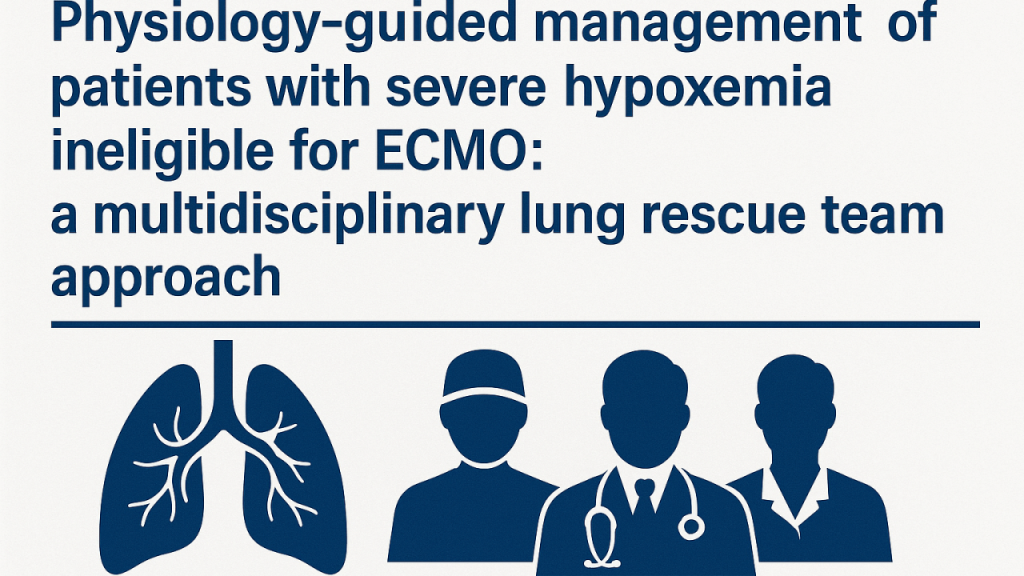
Physiology-guided management of patients with severe hypoxemia ineligible for ECMO: a multidisciplinary lung rescue team approach

Abstract Not all patients with refractory hypoxemia meet ECMO criteria — yet many still face catastrophic oxygenation failure with limited options. This study describes a physiology-guided “Lung Rescue Team (LRT)” model, designed to evaluate patients who are ineligible or borderline for ECMO by integrating mechanical ventilation physiology, multimodal imaging, hemodynamics, gas exchange, and lung recruitability

Physiology-guided management of patients with severe hypoxemia ineligible for ECMO: a multidisciplinary lung rescue team approach Read Post »

Respiratory

A clinical guide to non-invasive respiratory support in acute respiratory failure: ventilation settings, technical optimization and clinical indications

Why this paper matters on a busy ICU day Non-invasive respiratory support (NIRS) is now everywhere: ED, step-down, wards, and ICU. We use HFNT, CPAP, BiPAP, facemasks, helmets — often driven by habit or availability more than physiology. Rezoagli and colleagues offer a practical, physiology-heavy roadmap for how to choose a modality, how to set

, , ,

A clinical guide to non-invasive respiratory support in acute respiratory failure: ventilation settings, technical optimization and clinical indications Read Post »

Respiratory

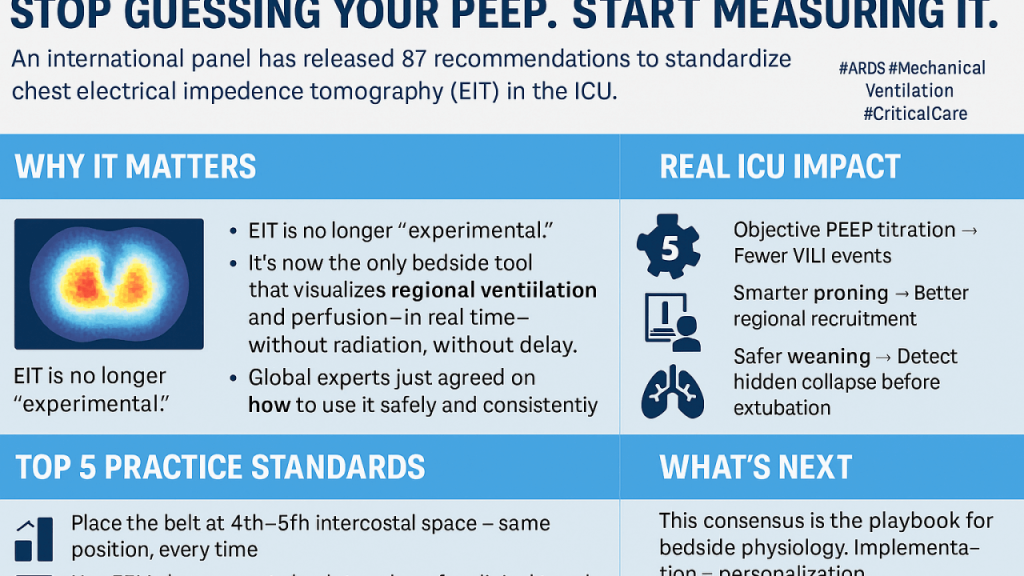
Recommendations for lung ventilation and perfusion assessment with chest electrical impedance tomography in critically ill adult patients.

Global Consensus on Electrical Impedance Tomography in Critical Care 🩺 Abstract Electrical Impedance Tomography (EIT) is a non-invasive, radiation-free imaging technology that allows continuous bedside monitoring of lung ventilation and perfusion in critically ill patients. Despite its increasing use, standardized international guidelines have been lacking. This large-scale Delphi consensus study—led by the REspiratory and Critical

, ,

Recommendations for lung ventilation and perfusion assessment with chest electrical impedance tomography in critically ill adult patients. Read Post »

Scroll to Top