Cardiovascular

Cardiovascular, Mechanical Ventilation

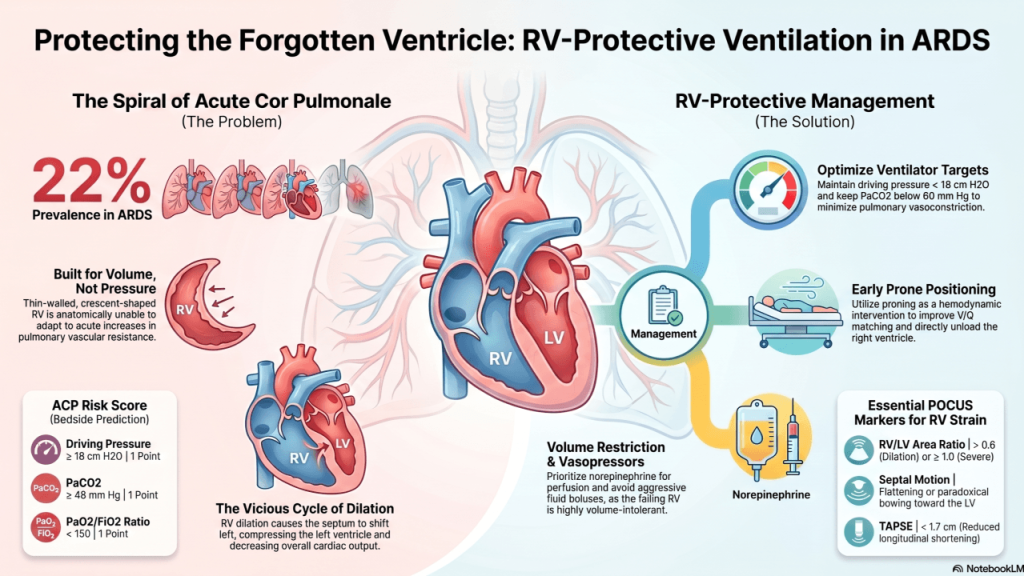
The Forgotten Ventricle Is Killing Your ARDS Patients — and the Ventilator You Are Using to Save Them May Be the Reason Why.

22% of patients with moderate-to-severe ARDS develop acute cor pulmonale on protective ventilation. The right ventricle was never designed to handle pressure — and every PEEP increase, every hypercapnic minute, and every overdistended breath you deliver is loading a chamber that was built to fail. Here is how to recognize it, prevent it, and treat […]

,

The Forgotten Ventricle Is Killing Your ARDS Patients — and the Ventilator You Are Using to Save Them May Be the Reason Why. Read Post »

Cardiovascular

Crossing the line: blood transfusion thresholds in ECMO

1. Why this editorial matters — and why you should read it ECMO teams across the world ask the same question daily: “What hemoglobin level actually improves oxygen delivery in ECMO — and when does transfusion do more harm than good?” Despite decades of ECMO evolution, there is still no evidence-based transfusion threshold for ECMO

, , ,

Crossing the line: blood transfusion thresholds in ECMO Read Post »

Cardiovascular

Prognostic implication of venoarterial extracorporeal membrane oxygenation in acute myocardial infarction-related cardiogenic shock

Summary This retrospective study aimed to evaluate clinical outcomes in patients receiving veno-arterial extracorporeal membrane oxygenation (VA-ECMO) for cardiogenic shock (CS), comparing acute myocardial infarction-related cardiogenic shock (AMI-CS) with non-AMI-CS. Analysis of data from 667 patients treated between 2008 and 2023 showed that AMI-CS was associated with significantly lower in-hospital mortality compared to non-AMI-CS. Independent

, , ,

Prognostic implication of venoarterial extracorporeal membrane oxygenation in acute myocardial infarction-related cardiogenic shock Read Post »

Cardiovascular

The role of serial point-of-care ultrasound during cardiac arrest to predict termination of resuscitation

Summary This prospective cohort study evaluated the utility of serial point-of-care ultrasound (POCUS) during cardiopulmonary resuscitation (CPR) to determine optimal timing for terminating resuscitation efforts in patients presenting with non-shockable cardiac arrest rhythms. Conducted in two academic hospitals, serial ultrasounds every two minutes were used to measure cardiac standstill duration and predict return of spontaneous

, , ,

The role of serial point-of-care ultrasound during cardiac arrest to predict termination of resuscitation Read Post »

Cardiovascular, Circulatory

Ethical Considerations for Patients Requiring Extracorporeal Cardiopulmonary Resuscitation

Summary The article explores ethical considerations surrounding extracorporeal cardiopulmonary resuscitation (eCPR), highlighting its potential as an advanced intervention to improve survival and neurological outcomes in cardiac arrest patients. Despite its promising clinical advantages, integrating eCPR into routine advanced life support (ALS) protocols poses significant ethical challenges, including increased demand for long-term care, resource allocation dilemmas,

, , , , ,

Ethical Considerations for Patients Requiring Extracorporeal Cardiopulmonary Resuscitation Read Post »

Cardiovascular

Thrombocytopenia in the intensive care unit: diagnosis and management

Summary Thrombocytopenia is a common complication among critically ill patients, defined by platelet counts below 150 × 10⁹/L or a relative decrease by more than 30–50%. It significantly impacts patient outcomes due to increased bleeding risks and worse prognoses. The mechanisms underlying thrombocytopenia in the ICU are diverse, involving peripheral consumption, destruction, sequestration, dilution, or

, ,

Thrombocytopenia in the intensive care unit: diagnosis and management Read Post »

Cardiovascular, Respiratory

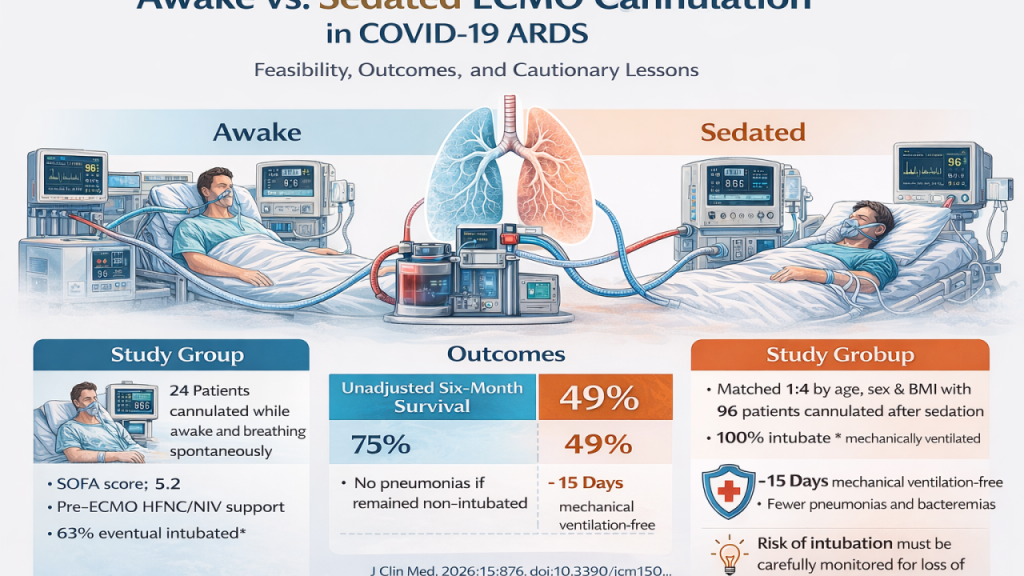
Awake vs. Sedated Cannulation for Extra-Corporeal Membrane Oxygenation in Patients with COVID-19 Induced Acute Respiratory Distress Syndrome

Why this article matters   Veno-venous extracorporeal membrane oxygenation (VV-ECMO) is routinely initiated in patients with severe ARDS after intubation, deep sedation, and often neuromuscular blockade. During the COVID-19 pandemic, however, some centers explored an alternative strategy: awake ECMO cannulation, in which patients are cannulated while spontaneously breathing and supported without invasive mechanical ventilation. The

, , , ,

Awake vs. Sedated Cannulation for Extra-Corporeal Membrane Oxygenation in Patients with COVID-19 Induced Acute Respiratory Distress Syndrome Read Post »

Cardiovascular

Advances in resuscitation and deresuscitation

Summary This review discusses significant recent developments in fluid resuscitation and deresuscitation practices within critical care, highlighting a paradigm shift toward conservative, personalized fluid management. Advances in fluid stewardship, goal-directed fluid therapy (GDFT), and innovative monitoring tools, including automated closed-loop systems and machine learning, support a precision medicine approach. The authors advocate for balanced resuscitation

, , ,

Advances in resuscitation and deresuscitation Read Post »

Cardiovascular

Cardiogenic shock syndrome unraveled: understanding the different layers of heterogeneity

Summary Cardiogenic shock (CS) represents a heterogeneous clinical syndrome characterized by sustained tissue hypoperfusion due to cardiac dysfunction, encompassing diverse etiological, hemodynamic, and molecular profiles. The paper emphasizes the need for recognizing CS heterogeneity through clinical classification, ventriculo-arterial coupling, macro- and microcirculatory considerations, and molecular subphenotyping. These multiple layers of complexity suggest that personalized medicine

,

Cardiogenic shock syndrome unraveled: understanding the different layers of heterogeneity Read Post »

Cardiovascular, Circulatory

Does targeted temperature management at 33 °C improve outcome after cardiac arrest?

Summary The article explores targeted temperature management (TTM) at 33°C as a treatment for patients following cardiac arrest, presenting arguments both in favor and against its use. TTM has been extensively debated due to conflicting clinical trial outcomes, variability in evidence from systematic reviews, and differences in interpretation of clinical utility. This review critically assesses

, ,

Does targeted temperature management at 33 °C improve outcome after cardiac arrest? Read Post »

Scroll to Top