Miscellaneous

Miscellaneous

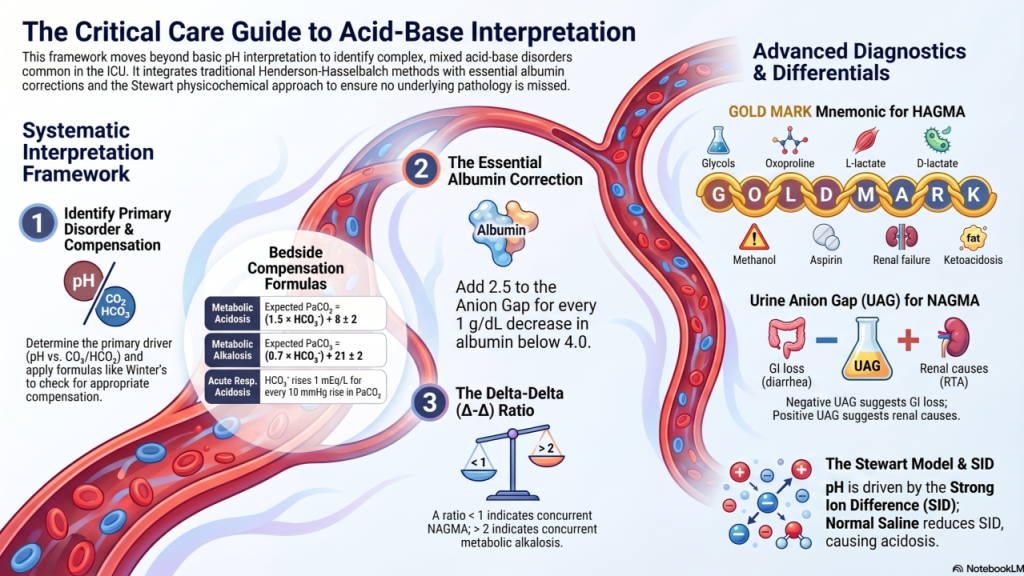
The Definitive Guide to Acid-Base Physiology in Critical Care: From Henderson-Hasselbalch to Stewart, From the ABG to the Bedside.

The Henderson-Hasselbalch equation. Winter’s formula. The anion gap. The delta-delta ratio. The albumin correction. The osmolar gap. The Stewart approach. The strong ion difference. The strong ion gap. Compensation rules for every primary disorder. Mnemonics for every differential. This is the article that replaces a textbook chapter — and it does not leave a single […]

,

The Definitive Guide to Acid-Base Physiology in Critical Care: From Henderson-Hasselbalch to Stewart, From the ABG to the Bedside. Read Post »

Miscellaneous

The metabolic response to stress in critical illness: updated review on the pathophysiological mechanisms, consequences, and therapeutic implications

Why this article matters Critical illness triggers a profound, highly coordinated metabolic stress response that extends far beyond “hypercatabolism.” This comprehensive review reframes how we understand energy metabolism, nutrition, endocrine signaling, immune function, and recovery across the acute, subacute, and chronic phases of critical illness. Importantly, it challenges long-standing assumptions around “early full feeding” and

, , ,

The metabolic response to stress in critical illness: updated review on the pathophysiological mechanisms, consequences, and therapeutic implications Read Post »

Miscellaneous

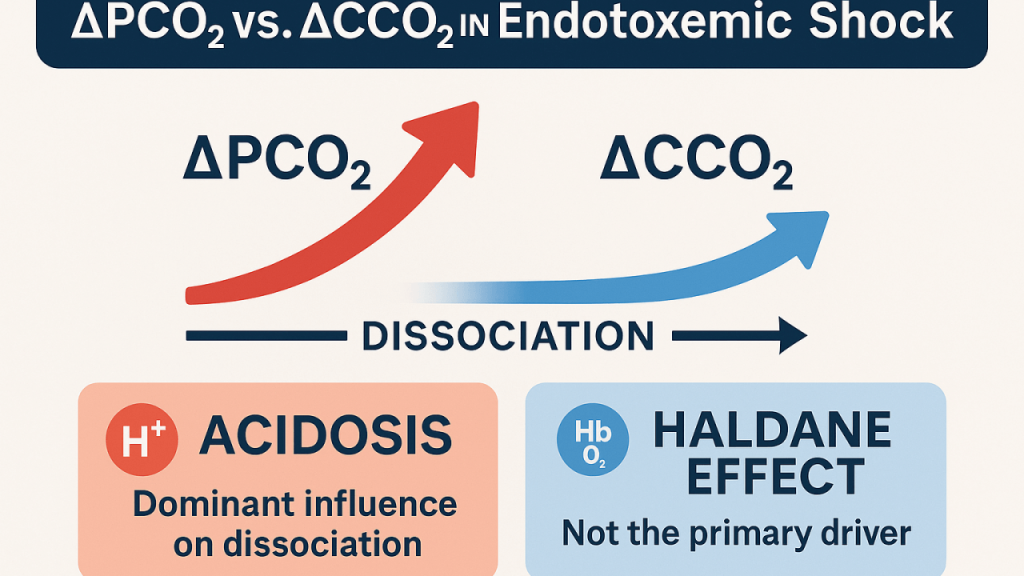
Regional venous-to-arterial carbon dioxide pressure and content differences during endotoxemic shock: influence of hydrogen ion accumulation vs…..

Abstract: This study investigated whether discrepancies between venous-to-arterial carbon dioxide pressure (ΔPCO₂) and content differences (ΔCCO₂) during endotoxemic shock are primarily influenced by hydrogen ion accumulation (acidosis) or hemoglobin oxygen saturation (Haldane effect). Using a porcine endotoxemia model, researchers induced and resuscitated shock with fluids and norepinephrine, measuring systemic and mesenteric CO₂ parameters. Key Insights:

,

Regional venous-to-arterial carbon dioxide pressure and content differences during endotoxemic shock: influence of hydrogen ion accumulation vs….. Read Post »

Miscellaneous

Exercise in patients with a tracheostomy and speaking valve: a randomised crossover-controlled trial

Can Patients Safely Exercise With a Speaking Valve in Place? Abstract: This randomized crossover-controlled study evaluated 20 ICU patients with tracheostomies performing in-bed cycle ergometry with versus without a speaking valve (SV). Safety was assessed via lung aeration using electrical impedance tomography (EIT), vital signs, and patient experience. Key Insights: Safety: No adverse events occurred

,

Exercise in patients with a tracheostomy and speaking valve: a randomised crossover-controlled trial Read Post »

Miscellaneous

Extracellular vesicles from bronchoalveolar lavage fluid provide insights into the inhaled corticosteroids treatment response in COPD

Abstract In a comprehensive proteomic analysis of sputum from patients in the WISDOM trial, Fang et al. identified cystatin SN (CST1) as a promising biomarker linked to better responses to inhaled corticosteroids (ICS) in COPD. Elevated CST1 levels—along with other related proteins—were consistently associated with reduced exacerbations and improved outcomes, particularly in patients with higher

, ,

Extracellular vesicles from bronchoalveolar lavage fluid provide insights into the inhaled corticosteroids treatment response in COPD Read Post »

Miscellaneous

Consensus recommendations for the integration of critical care pharmacists on intensive care unit teams: Endorsed by the American Association of……

Summary This article presents consensus recommendations developed to optimize the integration of critical care pharmacists (CCPs) within multidisciplinary intensive care unit (ICU) teams. Recognizing the proven benefits of CCPs, including improved patient outcomes and enhanced medication safety, the recommendations focus on standards, infrastructure, and best practices for implementing CCPs effectively. Developed using a modified Delphi

,

Consensus recommendations for the integration of critical care pharmacists on intensive care unit teams: Endorsed by the American Association of…… Read Post »

Miscellaneous

Choosing wisely: who really benefits from critical care EEG monitoring?

Summary This commentary explores the clinical utility and challenges associated with critical care continuous electroencephalogram (cEEG) monitoring, particularly focusing on critically ill patients experiencing seizures and status epilepticus. The authors examine recent evidence suggesting limited differences in outcomes between cEEG and routine EEG approaches, highlighting uncertainties around whether seizures observed in critical illness independently contribute

Choosing wisely: who really benefits from critical care EEG monitoring? Read Post »

Miscellaneous

Electrical impedance tomography in congenital heart disease: advancing non-invasive pulmonary perfusion assessment at bedside

Summary This article explores the use of electrical impedance tomography (EIT) for assessing pulmonary perfusion in critically ill pediatric patients with congenital heart disease (CHD). The study demonstrates the reliability and accuracy of EIT, a non-invasive, real-time, bedside, and radiation-free technique, through three complex clinical cases. The results from EIT were consistent with those obtained

,

Electrical impedance tomography in congenital heart disease: advancing non-invasive pulmonary perfusion assessment at bedside Read Post »

Miscellaneous, Uncategorized

Demystifying Volume Status

Summary Accurate evaluation of patient volume status is crucial yet challenging, impacting critical decisions on fluid management and vasoactive therapies. Traditional clinical methods often lack precision due to complexities in fluid distribution and homeostasis. This review provides a structured physiologic framework leveraging point-of-care ultrasound (POCUS) to assess volume status comprehensively. It emphasizes integrating central venous

,

Demystifying Volume Status Read Post »

Circulatory, Miscellaneous

Measurement and interpretation of central venous pressure: a narrative review

Summary This narrative review explores the historical development, physiological underpinnings, measurement techniques, and clinical relevance of central venous pressure (CVP) in perioperative and critical care settings. Although traditionally used as a marker for fluid responsiveness and intravascular volume status, evidence now emphasizes that CVP alone is unreliable for guiding fluid therapy. Nonetheless, when used alongside

Measurement and interpretation of central venous pressure: a narrative review Read Post »

Scroll to Top