acid–base balance

Miscellaneous

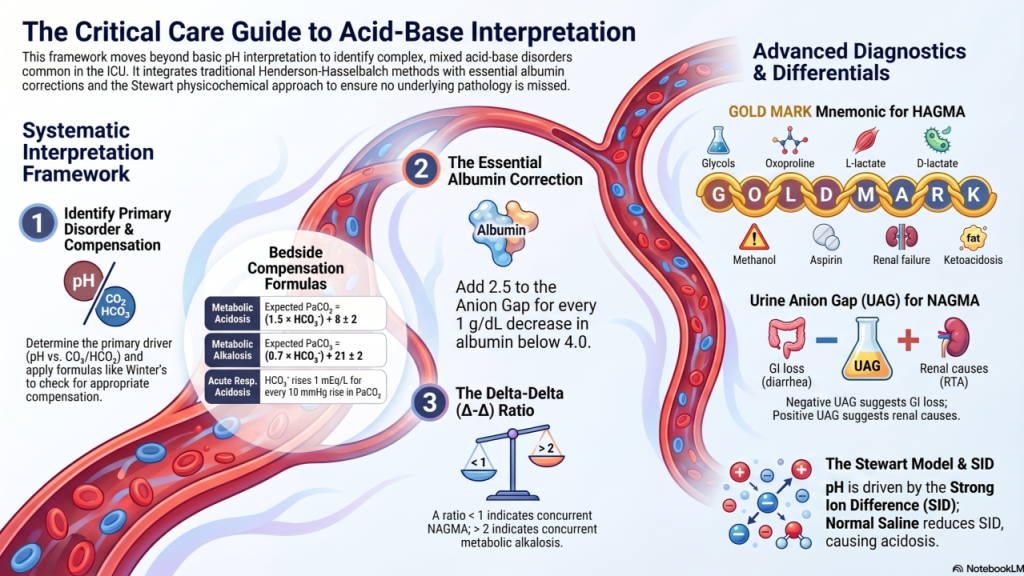
The Definitive Guide to Acid-Base Physiology in Critical Care: From Henderson-Hasselbalch to Stewart, From the ABG to the Bedside.

The Henderson-Hasselbalch equation. Winter’s formula. The anion gap. The delta-delta ratio. The albumin correction. The osmolar gap. The Stewart approach. The strong ion difference. The strong ion gap. Compensation rules for every primary disorder. Mnemonics for every differential. This is the article that replaces a textbook chapter — and it does not leave a single […]

,

The Definitive Guide to Acid-Base Physiology in Critical Care: From Henderson-Hasselbalch to Stewart, From the ABG to the Bedside. Read Post »

Miscellaneous

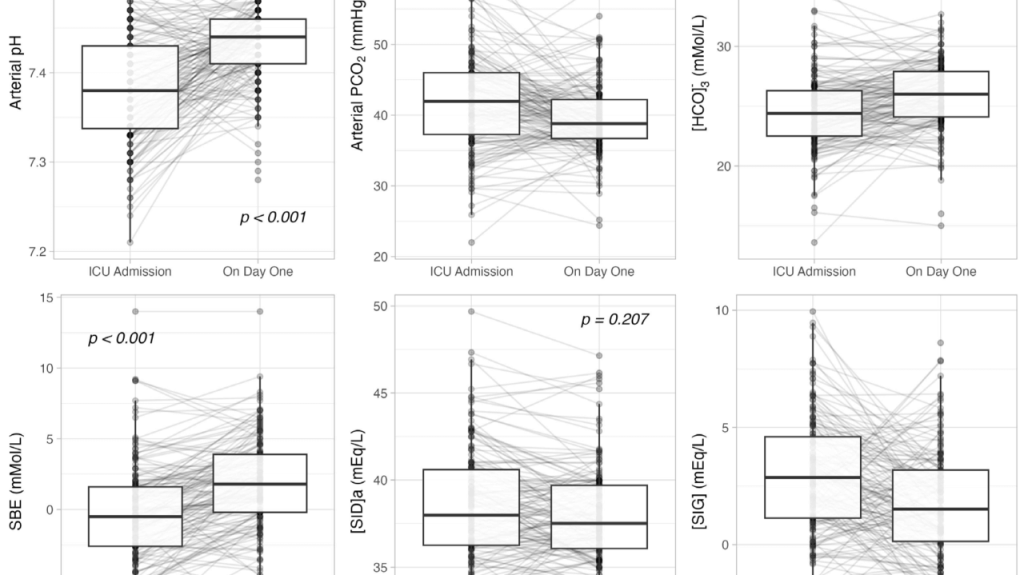
Acid–Base Status in Critically Ill Patients: Physicochemical vs. Traditional Approach

Summary Ciabattoni et al. conducted a prospective observational study to evaluate the prevalence and progression of acid–base disturbances in mechanically ventilated ICU patients using traditional (standard base excess—SBE) and physicochemical (Stewart method) approaches. They found significant differences in diagnostic accuracy between the two methods, with poor agreement, highlighting the Stewart method’s potential superiority in capturing

Acid–Base Status in Critically Ill Patients: Physicochemical vs. Traditional Approach Read Post »

Uncategorized

Complexities, Benefits, Risks, and Clinical Implications of Sodium Bicarbonate Administration in Critically Ill Patients: A State-of-the-Art Review

Abstract Sodium bicarbonate has been used in the treatment of different pathologies, such as hyperkalemia, cardiac arrest, tricyclic antidepressant toxicity, aspirin toxicity, acute acidosis, lactic acidosis, diabetic ketoacidosis, rhabdomyolysis, and adrenergic receptors’ resistance to catecholamine in patients with shock. An ongoing debate about bicarbonate’s efficacy and potential harm has been raised for decades because of

, , , ,

Complexities, Benefits, Risks, and Clinical Implications of Sodium Bicarbonate Administration in Critically Ill Patients: A State-of-the-Art Review Read Post »

Scroll to Top