Author name: admin

Cardiovascular, Mechanical Ventilation

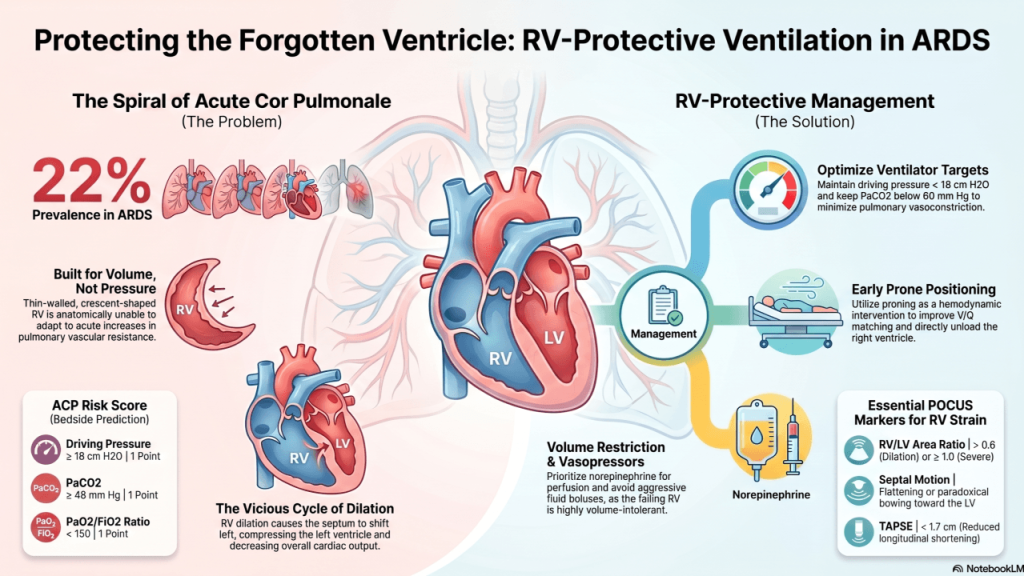
The Forgotten Ventricle Is Killing Your ARDS Patients — and the Ventilator You Are Using to Save Them May Be the Reason Why.

22% of patients with moderate-to-severe ARDS develop acute cor pulmonale on protective ventilation. The right ventricle was never designed to handle pressure — and every PEEP increase, every hypercapnic minute, and every overdistended breath you deliver is loading a chamber that was built to fail. Here is how to recognize it, prevent it, and treat […]
,

The Forgotten Ventricle Is Killing Your ARDS Patients — and the Ventilator You Are Using to Save Them May Be the Reason Why. Read Post »

Miscellaneous

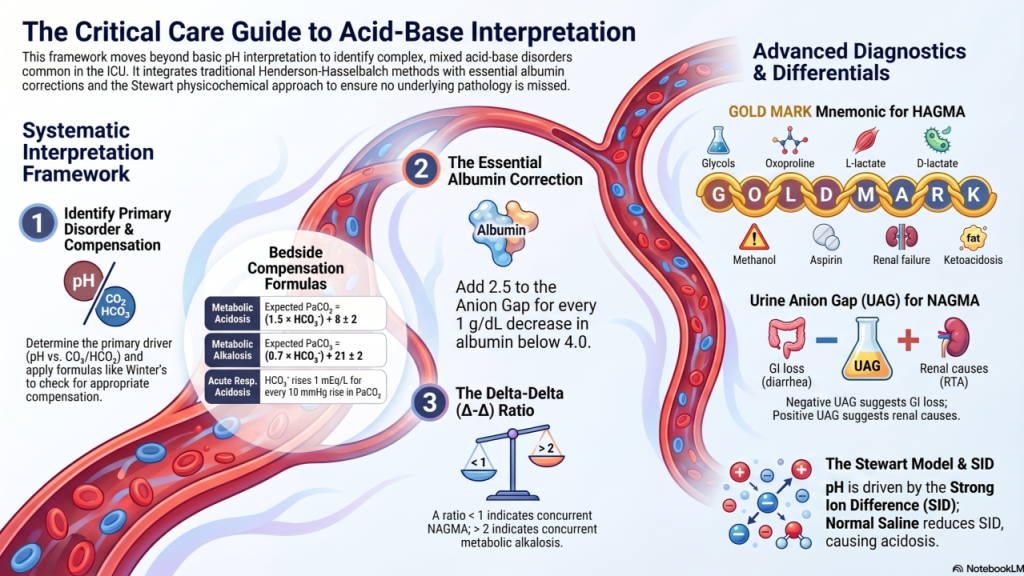
The Definitive Guide to Acid-Base Physiology in Critical Care: From Henderson-Hasselbalch to Stewart, From the ABG to the Bedside.

The Henderson-Hasselbalch equation. Winter’s formula. The anion gap. The delta-delta ratio. The albumin correction. The osmolar gap. The Stewart approach. The strong ion difference. The strong ion gap. Compensation rules for every primary disorder. Mnemonics for every differential. This is the article that replaces a textbook chapter — and it does not leave a single

,

The Definitive Guide to Acid-Base Physiology in Critical Care: From Henderson-Hasselbalch to Stewart, From the ABG to the Bedside. Read Post »

Respiratory

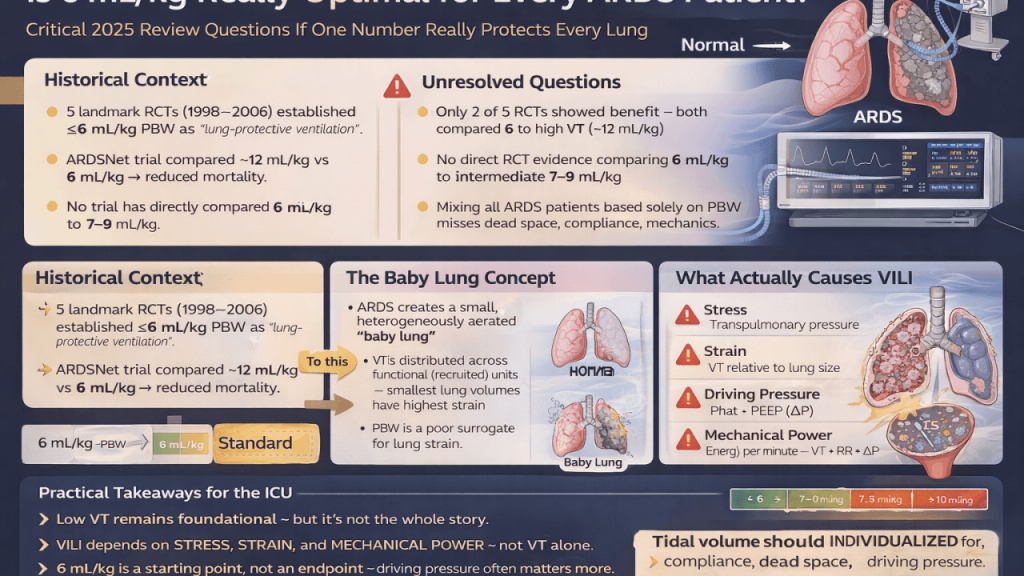
Lung-protective ventilation strategy in acute respiratory distress syndrome: a critical reappraisal of current practice

Why This Article Matters For more than 20 years, lung-protective ventilation has been synonymous with a single number: 6 mL/kg predicted body weight (PBW). This target has been taught, audited, benchmarked, and enforced across ICUs worldwide. Yet despite near-universal endorsement, real-world adherence remains inconsistent—and outcomes have plateaued. This 2025 review asks an uncomfortable but necessary

, , ,

Lung-protective ventilation strategy in acute respiratory distress syndrome: a critical reappraisal of current practice Read Post »

Miscellaneous

The metabolic response to stress in critical illness: updated review on the pathophysiological mechanisms, consequences, and therapeutic implications

Why this article matters Critical illness triggers a profound, highly coordinated metabolic stress response that extends far beyond “hypercatabolism.” This comprehensive review reframes how we understand energy metabolism, nutrition, endocrine signaling, immune function, and recovery across the acute, subacute, and chronic phases of critical illness. Importantly, it challenges long-standing assumptions around “early full feeding” and

, , ,

The metabolic response to stress in critical illness: updated review on the pathophysiological mechanisms, consequences, and therapeutic implications Read Post »

Pharmacological Insights in Critical Care

Corticosteroids and hospital-acquired pneumonia

1. Why This Article Matters — Why You Should Read This Corticosteroids are everywhere in critical care. ARDS. Septic shock. COVID-19. Refractory hypoxemia. But when it comes to hospital-acquired pneumonia (HAP) and ventilator-associated pneumonia (VAP), their role remains controversial, inconsistently applied, and poorly understood. This narrative review tackles a clinically uncomfortable reality: While steroids may

, ,

Corticosteroids and hospital-acquired pneumonia Read Post »

Mechanical Ventilation, Respiratory

Invasive ventilator exhaust in critical care: aerosol transmission risks and management strategies-a narrative review

1. Why This Article Matters Invasive mechanical ventilation is the cornerstone of critical care. Yet, one major risk remains overlooked in daily practice: Ventilator exhaust can carry infectious aerosols, biofilm fragments, volatile anesthetics, and VOCs into the ICU environment — posing real risks for patients and staff. This review synthesizes decades of microbiology, aerosol physics,

, ,

Invasive ventilator exhaust in critical care: aerosol transmission risks and management strategies-a narrative review Read Post »

Respiratory

Patient-specific prediction of regional lung mechanics in patients with ARDS with physics-based models: a validation study

1. Why This Study Matters — Why You Should Read This Physiology at the bedside is often guesswork. We titrate PEEP. We adjust driving pressure. We interpret compliance as a global signal, even though ARDS is intensely regional. But imagine if we had a patient-specific digital model — a “virtual twin” — that could simulate

Patient-specific prediction of regional lung mechanics in patients with ARDS with physics-based models: a validation study Read Post »

Mechanical Ventilation

Individualised treatment effects of enhanced early mobilisation in mechanically ventilated patients: a secondary analysis of the TEAM trial

1. Why This Study Matters — Why You Should Read This Early mobilization is one of the most widely endorsed ICU practices. We repeat it daily: “Mobilize early. Mobilize often.” But what if that guidance is too simple? This new secondary analysis of the landmark TEAM trial challenges one of the core assumptions in ICU

, ,

Individualised treatment effects of enhanced early mobilisation in mechanically ventilated patients: a secondary analysis of the TEAM trial Read Post »

Respiratory

Balancing the Scales: Using Ventilator Time to Counter Mass Loading

Why This Study Matters — Why You Should Read This Obesity. Abdominal compartment syndrome. Massive chest wall load. We see these patients every day. We crank up PEEP, perform recruitment maneuvers, increase pressures…and yet the lung refuses to open. So what if the problem isn’t pressure at all? What if the missing variable is time?

, ,

Balancing the Scales: Using Ventilator Time to Counter Mass Loading Read Post »

Cardiovascular

Crossing the line: blood transfusion thresholds in ECMO

1. Why this editorial matters — and why you should read it ECMO teams across the world ask the same question daily: “What hemoglobin level actually improves oxygen delivery in ECMO — and when does transfusion do more harm than good?” Despite decades of ECMO evolution, there is still no evidence-based transfusion threshold for ECMO

, , ,

Crossing the line: blood transfusion thresholds in ECMO Read Post »

Scroll to Top