mechanical ventilation

Mechanical Ventilation, Miscellaneous

Echocardiography in the Ventilated Patient: What the Clinician Has to Know

Abstract Heart and lung sharing the same anatomical space are influenced by each other. Spontaneous breathing induces dynamic changes in intrathoracic pressure, impacting cardiac function, particularly the right ventricle. In intensive care units (ICU), mechanical ventilation (MV) and therefore positive end-expiratory pressure (PEEP) are often applied, and this inevitably influences cardiac function. In ventilated patients, […]

, , , , , ,

Echocardiography in the Ventilated Patient: What the Clinician Has to Know Read Post »
Respiratory

The Management of Interstitial Lung Disease in the ICU: A Comprehensive Review

Abstract Interstitial lung disease (ILD) encompasses a diverse group of parenchymal lung diseases characterized by varying degrees of inflammation and/or fibrosis. Patients with ILD frequently require hospitalization, with many needing intensive care unit (ICU) admission, most often due to respiratory failure. The diagnosis and management of ILD in the ICU present unique challenges. Diagnosis primarily

, , ,

The Management of Interstitial Lung Disease in the ICU: A Comprehensive Review Read Post »

Mechanical Ventilation

What every paediatrician needs to know about mechanical ventilation

Abstract Invasive mechanical ventilation (MV) is one of the most practiced interventions in the intensive care unit (ICU) and is unmistakably lifesaving for children with acute respiratory failure (ARF). However, if delivered inappropriately (i.e. ignoring the respiratory system mechanics and not targeted to the need of the individual patient at a specific time point in

, , , , ,

What every paediatrician needs to know about mechanical ventilation Read Post »

Respiratory

Apnea Testing on Conventional Mechanical Ventilation During Brain Death Evaluation

Abstract Introduction The use of continuous positive airway pressure has been shown to improve the tolerance of the apnea test, a critical component of brain death evaluation. The ability to deactivate the apnea backup setting has made apnea testing possible using several conventional mechanical ventilators. Our goal was to evaluate the safety and efficacy of

, , ,

Apnea Testing on Conventional Mechanical Ventilation During Brain Death Evaluation Read Post »

Respiratory

Challenges in Transitioning from Controlled to Assisted Ventilation in Acute Respiratory Distress Syndrome (ARDS) Management

Abstract Acute respiratory distress syndrome (ARDS) presents significant challenges in critical care, primarily due to its inflammatory nature, which leads to impaired gas exchange and respiratory mechanics. While mechanical ventilation (MV) is essential for patient support, the transition from controlled to assisted ventilation is complex and may be associated with intensive care unit-acquired weakness, ventilator-induced

, ,

Challenges in Transitioning from Controlled to Assisted Ventilation in Acute Respiratory Distress Syndrome (ARDS) Management Read Post »

Uncategorized

Electrical impedance tomography monitoring in adult ICU patients: state-of-the-art, recommendations for standardized acquisition, processing, and clinical use, and future directions

Abstract Electrical impedance tomography (EIT) is an emerging technology for the non-invasive monitoring of regional distribution of ventilation and perfusion, offering real-time and continuous data that can greatly enhance our understanding and management of various respiratory conditions and lung perfusion. Its application may be especially beneficial for critically ill mechanically ventilated patients. Despite its potential, clear

, , , ,

Electrical impedance tomography monitoring in adult ICU patients: state-of-the-art, recommendations for standardized acquisition, processing, and clinical use, and future directions Read Post »

Mechanical Ventilation, Miscellaneous

How we use ultrasound in the management of weaning from mechanical ventilation

Difficult weaning from invasive mechanical ventilation is associated with adverse clinical outcome and increased use of limited health care resources. Difficult weaning, characterized by failure of multiple spontaneous breathing trails (SBTs), can result from several causes, including impaired function of lung, heart, and respiratory pump [1]. In this editorial, we discuss how ultrasound may facilitate

, , ,

How we use ultrasound in the management of weaning from mechanical ventilation Read Post »

Circulatory

ECMO-weaning facilitated by neurally adjusted ventilatory assist (NAVA): a case for principal clarification

Abstract The use of veno-venous extracorporeal membrane oxygenation (VV-ECMO) has become increasingly prevalent, particularly in respiratory disease pandemics such as H1N1-influenza and SARS-CoV-2. This surge has emphasized the importance of clear therapy recommendations, improved accessibility to ECMO technology, established ECMO teams, and structured networks to ensure access to specialized care throughout the course of the

, , , , , ,

ECMO-weaning facilitated by neurally adjusted ventilatory assist (NAVA): a case for principal clarification Read Post »

Mechanical Ventilation

What every paediatrician needs to know about mechanical ventilation

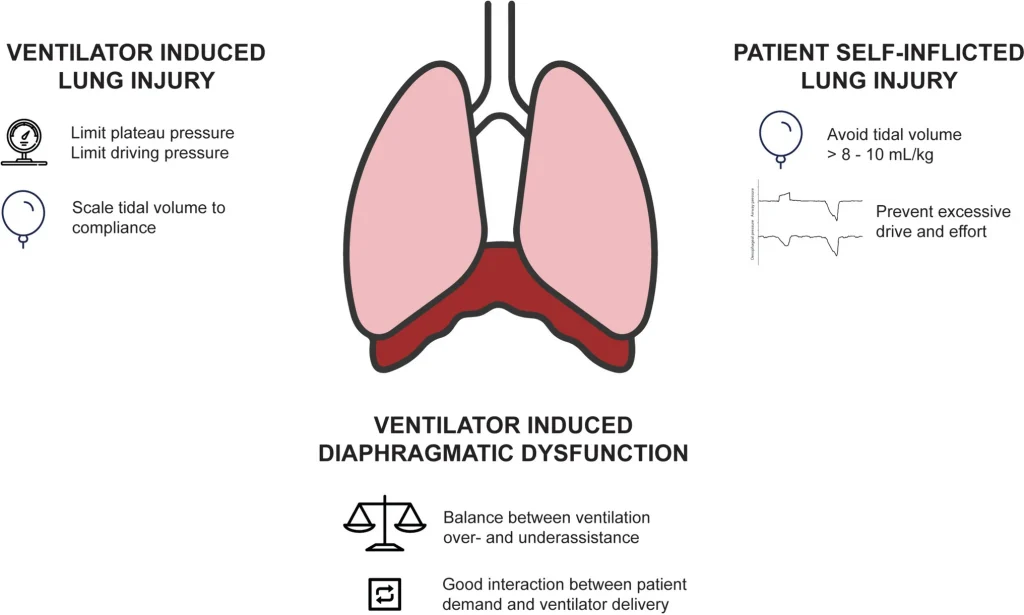
Abstract Mechanical ventilation (MV) is a lifesaving intervention for children with acute respiratory failure (ARF). However, improper application can lead to adverse outcomes, such as ventilation-induced lung injury (VILI), patient self-inflicted lung injury (P-SILI), and ventilation-induced diaphragmatic dysfunction (VIDD). This review discusses the fundamentals of MV, challenges in minimizing its side effects, and strategies to

What every paediatrician needs to know about mechanical ventilation Read Post »

Artificial Intelligence, Mechanical Ventilation, Pharmacological Insights in Critical Care, Respiratory

Barotrauma: The statistical fallacy. A non-conventional scoping review with Bayesian meta-analysis

Abstract Background Mechanical ventilator-associated damage has a high relevance in the clinical outcomes of critically ill patients. Barotrauma is a colloquial premise that has not been questioned, while other concepts such as mechanotransduction based on time-dependent viscoelastic models derived from materials engineering and physics appear as a more solid and clinically plausible postulate. This scoping

,

Barotrauma: The statistical fallacy. A non-conventional scoping review with Bayesian meta-analysis Read Post »

Scroll to Top