Author name: admin

Cardiovascular

Management of cardiogenic shock: state-of-the-art

Abstract: Jung et al. provide a comprehensive review addressing current knowledge and contemporary practices in the management of cardiogenic shock (CS). Despite advancements, mortality remains high, and the complexity of patient care underscores the need for individualized treatments. The authors highlight recent evidence in pharmacological therapies, mechanical circulatory support (MCS), and the potential for personalized […]

,

Management of cardiogenic shock: state-of-the-art Read Post »

Sepsis

Efficacy of targeting high mean arterial pressure for older patients with septic shock (OPTPRESS): a multicentre, pragmatic, open-label, randomised…

Abstract: Endo et al. conducted the OPTPRESS trial, a multicenter randomized controlled trial in Japan, evaluating whether a higher mean arterial pressure (MAP) target (80–85 mmHg) reduces mortality in older patients (≥65 years) with septic shock compared to standard targets (65–70 mmHg). The trial was terminated early due to increased mortality and adverse events in

, ,

Efficacy of targeting high mean arterial pressure for older patients with septic shock (OPTPRESS): a multicentre, pragmatic, open-label, randomised… Read Post »

Cardiovascular

Intraoperative extracorporeal support for lung transplant: a systematic review and network meta-analysis

Abstract: Pettenuzzo et al. conducted a systematic review and network meta-analysis evaluating the efficacy and safety of intraoperative extracorporeal supports—veno-arterial extracorporeal membrane oxygenation (V-A ECMO) and cardiopulmonary bypass (CPB)—compared to off-pump strategies during lung transplantation (LT). Their analysis revealed that off-pump approaches generally offered better outcomes, while V-A ECMO, particularly as a default strategy, showed

, ,

Intraoperative extracorporeal support for lung transplant: a systematic review and network meta-analysis Read Post »

Pulmonary

Pulmonary shunt in critical care: a practical approach with clinical scenarios

Abstract: Raimondi Cominesi et al. deliver an extensive review on pulmonary shunt, a critical physiological phenomenon where venous blood bypasses alveolar gas exchange, leading to impaired oxygenation. The authors provide practical methods to assess and calculate pulmonary shunt in various critical care scenarios, highlighting its clinical importance, especially in complex conditions such as acute respiratory

,

Pulmonary shunt in critical care: a practical approach with clinical scenarios Read Post »

Miscellaneous

How we use ultrasound to support clinical decisions on fluid administration in critical ill patients

🩺 How Ultrasound Guides Fluid Administration in Critical Illness Abstract: Intravenous fluids are among the most frequently used therapies in critical care but must be considered drugs, carrying both benefits and risks. Critical care ultrasound (CCUS)—through echocardiography (CCE), lung ultrasound (LUS), and venous excess ultrasound (VExUS)—offers a structured way to assess the risks and benefits

, , ,

How we use ultrasound to support clinical decisions on fluid administration in critical ill patients Read Post »

Pulmonary

Respiratory management of critically ill pneumocystis pneumonia patients: a multicenter retrospective study

🫁 Respiratory Management of Critically Ill Pneumocystis Pneumonia Patients Reizine F, Stiegler V, Lécuyer R, Tessoulin B, Gallais M, Camou F, Morio F, Cady A, Gabriel F, Canet E, Raffi F, Boutoille D, Issa N, Gaborit B, and the PRONOCYSTIS Study Group. Ann Intensive Care. 2025;15:114. doi:10.1186/s13613-025-01503-6 Abstract: Pneumocystis jirovecii pneumonia (PjP) is an emerging

Respiratory management of critically ill pneumocystis pneumonia patients: a multicenter retrospective study Read Post »

Respiratory

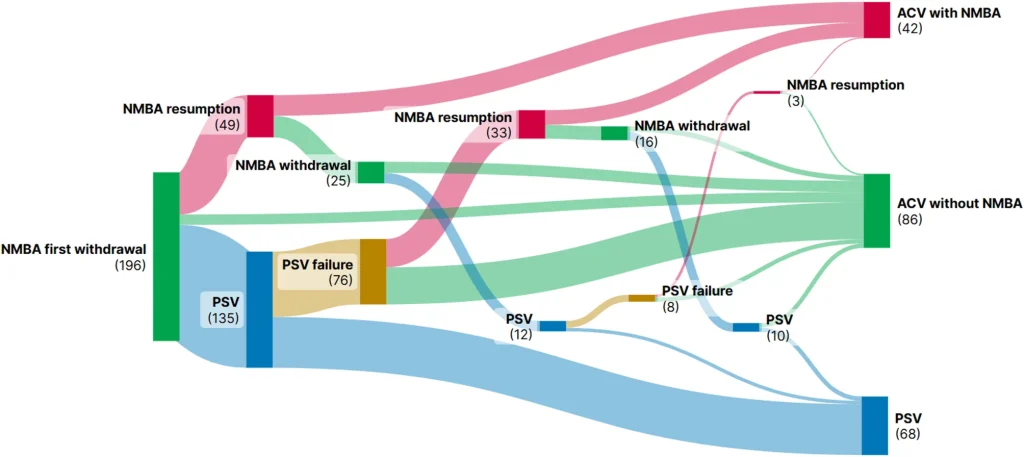
Factors influencing the transition phase in acute respiratory distress syndrome: an observational cohort study

🫁 Transition Phase in ARDS: Predictors of NMBA and PSV Failure Abstract: Protective ventilation and liberation strategies in ARDS are well established, but the transition phase—between stopping neuromuscular blockade (NMBA) and initiating assisted ventilation—remains poorly defined. This bicentric cohort study (n=196) evaluated predictors of NMBA weaning failure and pressure support ventilation (PSV) failure, focusing on

,

Factors influencing the transition phase in acute respiratory distress syndrome: an observational cohort study Read Post »

Respiratory

Lung electrical impedance tomography during positioning, weaning and chest physiotherapy in mechanically ventilated critically ill patients: a…

🫁 Lung EIT in Positioning, Weaning, and Chest Physiotherapy: A Narrative Review Abstract: Electrical impedance tomography (EIT) is a bedside, radiation-free imaging modality that measures ventilation and, with some techniques, perfusion. While most ICU studies have focused on ARDS and PEEP titration, this review explored EIT applications during positioning, weaning, and chest physiotherapy in intubated

Lung electrical impedance tomography during positioning, weaning and chest physiotherapy in mechanically ventilated critically ill patients: a… Read Post »

Mechanical Ventilation

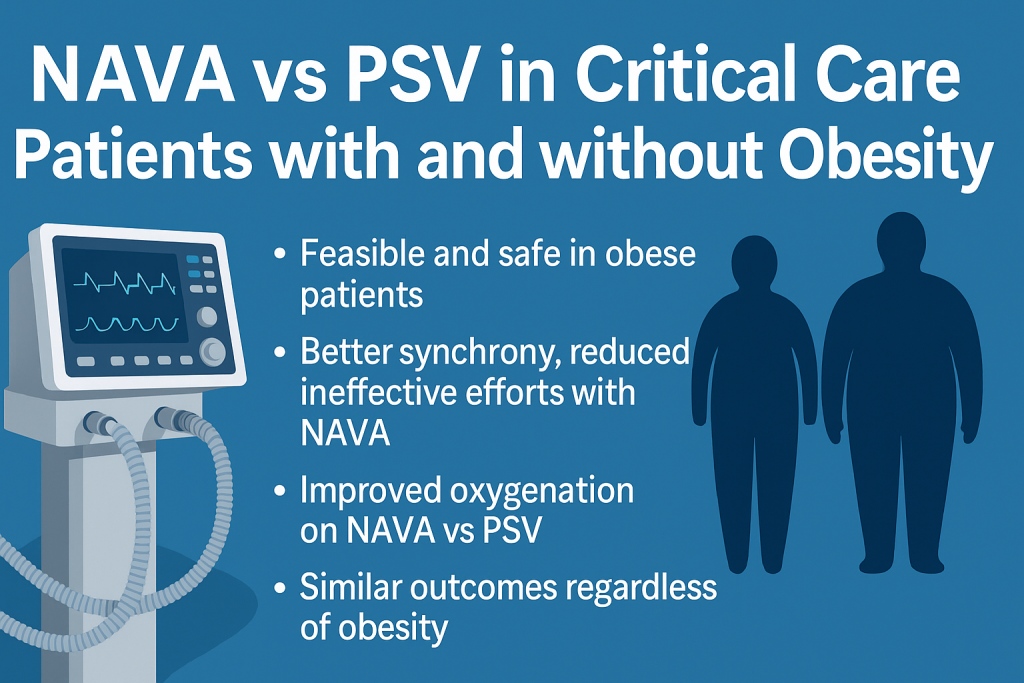
Neurally adjusted ventilatory assist in critical care patients with and without obesity: a prospective randomized crossover study

🫁 NAVA vs PSV in Obese ICU Patients: First Evidence of Safety and Benefit   Abstract: This randomized crossover study is the first to test Neurally Adjusted Ventilatory Assist (NAVA) in critically ill obese patients. Twenty-one ventilated patients (10 obese, 11 non-obese) underwent 30 minutes of NAVA and PSV each. Researchers assessed safety, patient-ventilator synchrony,

, ,

Neurally adjusted ventilatory assist in critical care patients with and without obesity: a prospective randomized crossover study Read Post »

Sepsis

Biomarkers to guide sepsis management

🧬 Biomarkers to Guide Sepsis Management: The Next Frontier Abstract: Sepsis remains a leading global cause of mortality and morbidity. This review highlights how biomarkers—from inflammatory mediators to endothelial and immune markers—are increasingly being used to guide key elements of sepsis management: early diagnosis, antibiotic stewardship, fluid therapy, vasopressor initiation, and immunotherapy. Precision therapeutics anchored

,

Biomarkers to guide sepsis management Read Post »

Scroll to Top