Brain injury

Circulatory

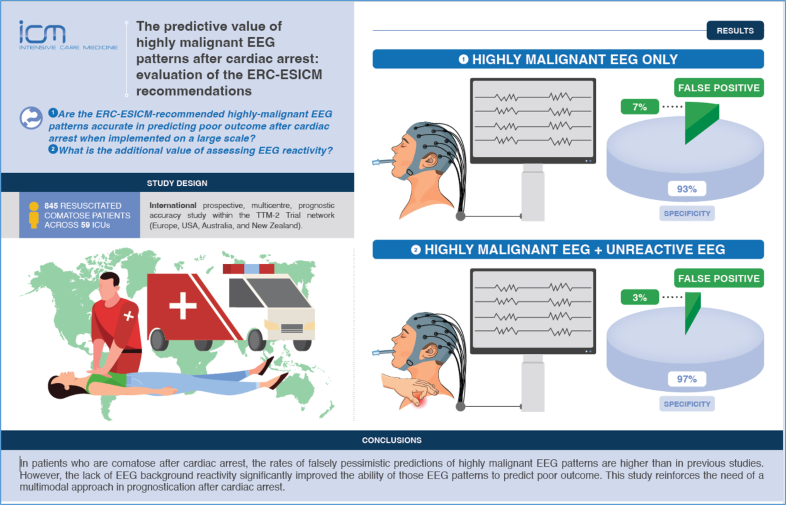
The predictive value of highly malignant EEG patterns after cardiac arrest: evaluation of the ERC-ESICM recommendations

Summary of The Predictive Value of Highly Malignant EEG Patterns After Cardiac Arrest: Evaluation of the ERC-ESICM Recommendations Abstract Highly malignant EEG patterns (HMEP), specifically suppression and burst-suppression, are recommended by the European Resuscitation Council (ERC) and the European Society of Intensive Care Medicine (ESICM) for predicting poor neurological outcomes after cardiac arrest. This study, […]

, , ,

The predictive value of highly malignant EEG patterns after cardiac arrest: evaluation of the ERC-ESICM recommendations Read Post »

Neurology

Metabolomic in severe traumatic brain injury: exploring primary, secondary injuries, diagnosis, and severity

Abstract Background Traumatic brain injury (TBI) is a major public health concern worldwide, contributing to high rates of injury-related death and disability. Severe traumatic brain injury (sTBI), although it accounts for only 10% of all TBI cases, results in a mortality rate of 30–40% and a significant burden of disability in those that survive. This

, , , ,

Metabolomic in severe traumatic brain injury: exploring primary, secondary injuries, diagnosis, and severity Read Post »

Neurology

The Pupillary Light-Off Reflex in Acute Disorders of Consciousness

Abstract Background In intensive care patients with disorders of consciousness, the pupillary light reflex is a measure of pupillary parasympathetic function. By contrast, the pupillary light-off reflex leads to pupil dilation in response to an abrupt change from light to darkness (“light-off”) and reflects combined parasympathetic and sympathetic pupillary function. To our knowledge, this reflex

, , ,

The Pupillary Light-Off Reflex in Acute Disorders of Consciousness Read Post »

Scroll to Top