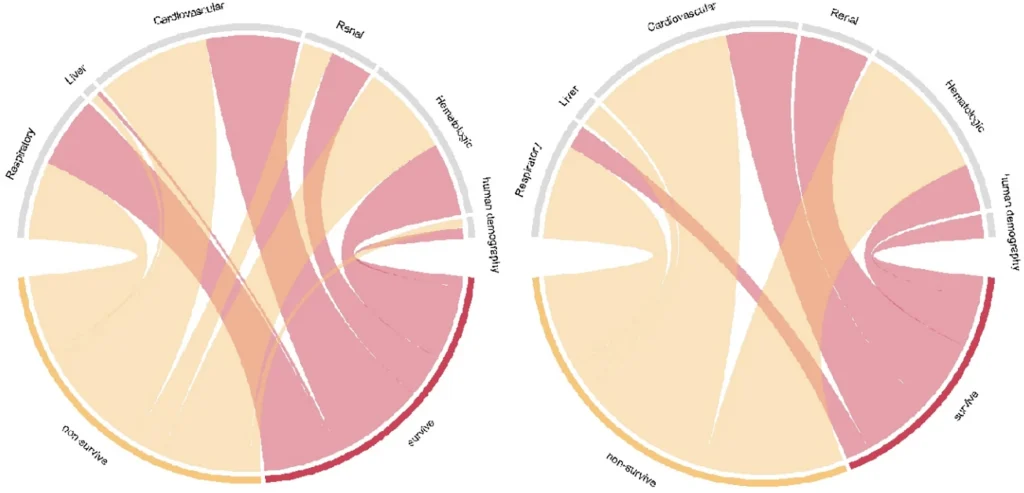
Summary of “Anion gap predicting 90-Day mortality and guiding furosemide use in ARDS”
Abstract This retrospective cohort study assessed whether the serum anion gap (AG), a marker of metabolic acidosis, could predict 90-day mortality in ARDS patients and guide furosemide use. Using the MIMIC-IV database, 11,227 patients with ARDS were analyzed. Higher AG levels correlated with increased mortality, and subgroup analyses indicated furosemide use provided protective effects particularly in patients with elevated AG. AG was confirmed as an independent predictor of mortality even after multivariable adjustment, suggesting that early AG evaluation could be clinically useful for prognosis and therapy selection.
Key Points:
-
Study Design and Population This was a retrospective cohort analysis using the MIMIC-IV database (version 2.2), including 11,227 ARDS patients, categorized by anion gap quartiles to assess mortality and treatment associations.
-
Prognostic Value of Anion Gap Elevated AG values within 24 hours of admission were significantly associated with higher 90-day all-cause mortality, independent of age, comorbidities, or other biochemical parameters, with Q4 showing the highest risk.
-
Anion Gap and Organ Dysfunction Higher AG levels reflected not only metabolic acidosis but also systemic hypoxia and multi-organ dysfunction, including liver and kidney impairment, as evidenced by increased ALT, AST, BUN, and creatinine.
-
Survival and AG Levels Survivors had significantly lower median AG values compared to non-survivors, highlighting AG as a meaningful discriminator in ARDS prognosis.
-
Furosemide’s Protective Effect in High AG Furosemide significantly improved survival in patients with AG levels >15.12 (cut-off based on RCS modeling), especially in Q4 (AG 19–55), where the adjusted HR was 0.57, suggesting targeted diuretic therapy may mitigate metabolic derangement.
-
Lack of Benefit in Intermediate AG Groups Interestingly, furosemide did not offer mortality benefits in patients with moderate AG values (Q2 and Q3), highlighting the importance of AG stratification in clinical decision-making.
-
Non-linear Mortality Risk Increase Restricted cubic spline modeling demonstrated a nearly linear increase in mortality risk with rising AG levels, validating its predictive strength across a spectrum of values.
-
Differentiated Treatment Outcomes While furosemide was beneficial, other treatments commonly used for metabolic acidosis (sodium bicarbonate, lactulose, calcium gluconate) did not show similar mortality interaction effects with AG levels.
-
Biochemical and Clinical Correlates High AG was associated with elevated lactate, decreased bicarbonate and pH, lower PO2, and increased ICU admission, reinforcing its role as a cumulative marker of metabolic and hypoxic stress.
-
Clinical Utility and Limitations Although AG is widely available and often overlooked, this study highlights its prognostic value in ARDS management; however, findings should be cautiously generalized due to the single-database design and retrospective nature.

Conclusion Serum anion gap is a valuable, underutilized prognostic marker in ARDS. Elevated AG correlates with increased 90-day mortality, and furosemide appears to confer survival benefits in patients with high AG. These findings suggest AG could guide early risk stratification and individualized treatment strategies in critical care.

Watch the following video on “ABG Interpretation: The Anion Gap (Lesson 5)” by Strong Medicine
Open Access This article is licensed under a Creative Commons Attribution 4.0 International License, which permits use, sharing, adaptation, distribution and reproduction in any medium or format, as long as you give appropriate credit to the original author(s) and the source, provide a link to the Creative Commons licence, and indicate if changes were made. The images or other third party material in this article are included in the article’s Creative Commons licence, unless indicated otherwise in a credit line to the material. If material is not included in the article’s Creative Commons licence and your intended use is not permitted by statutory regulation or exceeds the permitted use, you will need to obtain permission directly from the copyright holder. To view a copy of this licence, visit http://creativecommons.org/licenses/by/4.0/.