
Discover our section specialized in congenital heart disease pathologies, where you can find more than 200 pathologies.
Collaboration with Prof. Daniel Tobler and University of Basel
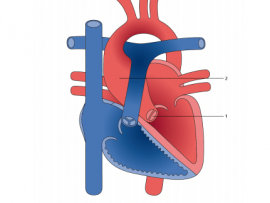

Congenital bicuspid aortic valve is a relatively rare malformation. It is reported that the presence of this anomaly predisposes the patient to development of true aortic aneurysms or dissecting aortic aneurysms. Between 1981 and August 1997, 25 patients with an aneurysm of the thoracic aorta associated with congenital bicuspid aortic..
Read More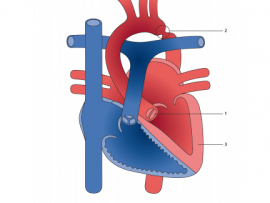
Bicuspid aortic valve (BAV) is the most common congenital heart defect with a prevalence of 1–2% and most commonly BAV is found in males with a rate of 1:2 varying to 1:4 (-). BAV is most commonly the result of fusion of the left and right coronary cusp (LCC and..
Read More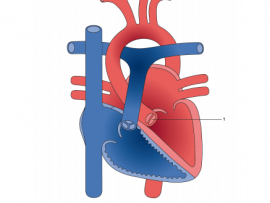
The aortic valve allows oxygen-rich blood to flow from the heart to the aorta. It prevents the blood from flowing back from the aorta into the heart when the pumping chamber relaxes. BAV is present at birth (congenital). An abnormal aortic valve develops during the early weeks of pregnancy, when..
Read More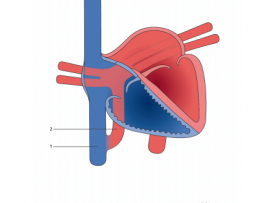
Total anomalous pulmonary venous connection (TAPVC) is a very rare congenital heart disease (CHD), reported in 1-2.6% of all congenital heart disease (-). The onset can be abrupt with cardiopulmonary insufficiency or mild, and it has no specific clinical picture. An important step in diagnosis of this entity is to..
Read More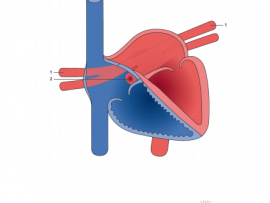
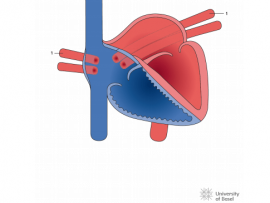
Total anomalous pulmonary venous connection (TAPVC) develops when the primordial pulmonary vein fails to unite with the plexus of veins surrounding the lung buds. In 1959, Darling and associates[] proposed a classification, also based on the anatomy of the anomalous connection. Four types were identified: type 1, anomalous connection at..
Read More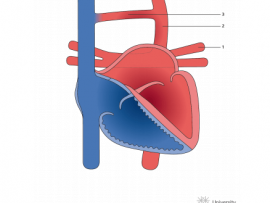
In this type of TAPVR, the pulmonary veins first come together behind the heart and then drain upwards to an abnormal “vertical vein.” This vertical vein joins the innominate vein which connects to the right superior vena cava and drains to the right atrium.
Read More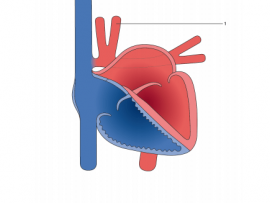
Anomalous pulmonary venous connection (APVC) is an uncommon congenital anomaly in which pulmonary venous blood flows directly into the right side of the heart or into the systemic veins. The venous abnormality may be partial or total. Total anomalous pulmonary venous connections (TAPVCs) represent approximately 1% to 3% of major..
Read More
Scimitar syndrome consists of a partial anomalous pulmonary venous drainage of right lung, right lung hypoplasia, dextraposition of heart, and anomalous systemic arterial supply from aorta or one of its branches to the right lung. This syndrome has varied presentations, from an asymptomatic state to severe pulmonary hypertension and/or heart failure. Those..
Read More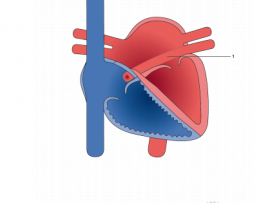
Partial anomalous pulmonary venous return, sometimes called partial anomalous pulmonary venous connection, is a heart defect present at birth (congenital) in which some of the pulmonary veins carrying blood from the lungs to the heart flow into other blood vessels or into the heart's upper right chamber (right atrium), instead..
Read More