
Procuring organs from a complex donor presenting with a double Azygos system


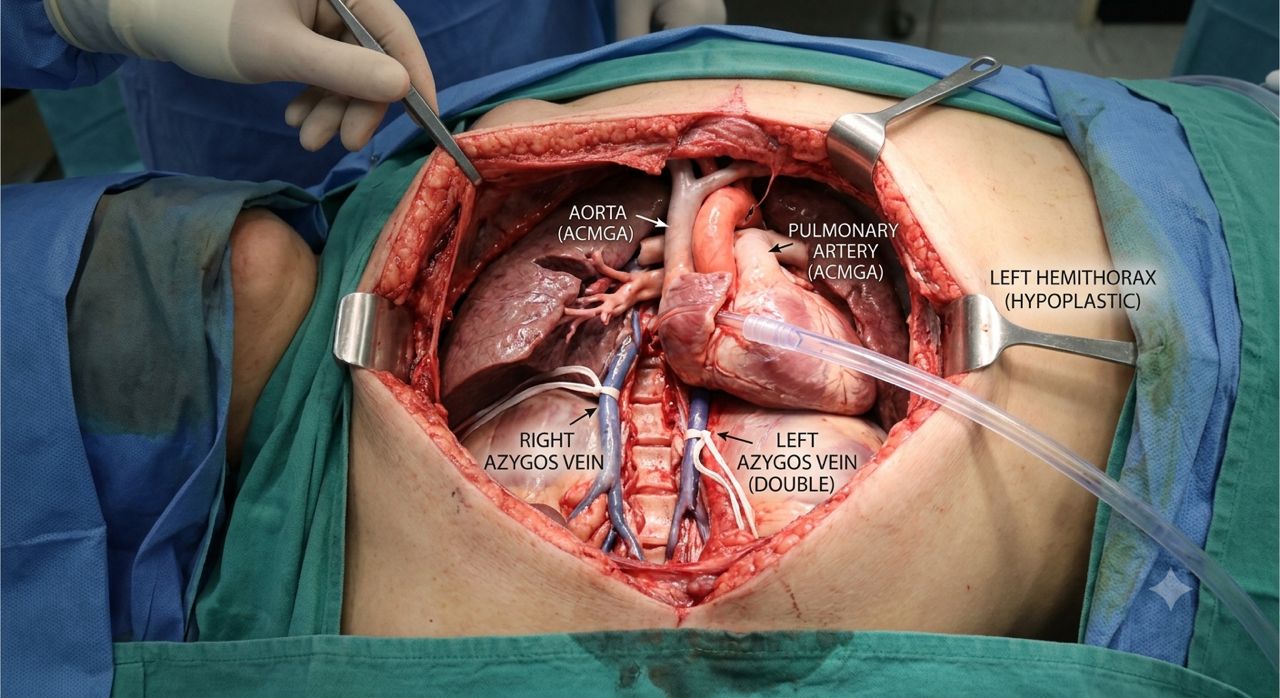
Procuring organs from a complex donor presenting with a double Azygos system, anatomically corrected malposition of the great arteries (ACMGA), a hypoplastic left hemithorax, and severe kyphoscoliosis requires meticulous anatomical mapping and tailored surgical access. Given the severe chest wall and spinal deformity, a standard midline sternotomy must be adjusted proactively, likely extending into a left anterolateral thoracotomy or hemi-clamshell approach to safely navigate the distorted mediastinal spatial relationships and the restricted left hemithorax.
Upon entering the chest, the presence of a double Azygos vein demands immediate structural identification; both the left and right Azygos systems must be carefully isolated and ligated to guarantee complete venous isolation and prevent systemic systemic-to-pulmonary shunting during cold preservation. The arterial phase must account for the parallel, non-transposed but spatially abnormal configuration of the great vessels inherent to ACMGA, where the ventriculoarterial connections are concordant but the aorta lies atypically (often anterior and leftward) relative to the pulmonary artery. Cannulation vectors for the cardioplegia line and the main flush must be precisely aligned with this parallel outflow geometry to ensure uniform myocardial and pulmonary protection. Simultaneously, because the left hemithorax is hypoplastic, the left lung will present with restricted parenchymal volume and potentially distorted hilar architecture; the main pulmonary artery flush and en bloc cross-clamp maneuvers must be executed under direct visual tracking of the hypoplastic left hillum to avoid accidental vascular torsion, guaranteeing symmetrical, pressure-controlled delivery of the preservation solution to both lungs.
Upon entering the chest, the presence of a double Azygos vein demands immediate structural identification; both the left and right Azygos systems must be carefully isolated and ligated to guarantee complete venous isolation and prevent systemic systemic-to-pulmonary shunting during cold preservation. The arterial phase must account for the parallel, non-transposed but spatially abnormal configuration of the great vessels inherent to ACMGA, where the ventriculoarterial connections are concordant but the aorta lies atypically (often anterior and leftward) relative to the pulmonary artery. Cannulation vectors for the cardioplegia line and the main flush must be precisely aligned with this parallel outflow geometry to ensure uniform myocardial and pulmonary protection. Simultaneously, because the left hemithorax is hypoplastic, the left lung will present with restricted parenchymal volume and potentially distorted hilar architecture; the main pulmonary artery flush and en bloc cross-clamp maneuvers must be executed under direct visual tracking of the hypoplastic left hillum to avoid accidental vascular torsion, guaranteeing symmetrical, pressure-controlled delivery of the preservation solution to both lungs.
Dr.Sam Zeraatian Nejad Davani, Cardiovascular and Transplant surgeon. Advanced Fellow of Thoracic Organs Transplantation Chicago Illinois.