


Abstract Floating thrombi of the aortic arch constitute rare yet highly consequential lesions with high embolic risk for which optimal management remains debated. Conventional surgical management typically requires deep hypothermic..
Read More
Abstract Background Lung-protective ventilation in acute respiratory distress syndrome (ARDS) can lead to hypercapnia, an independent risk factor for increased mortality. Extracorporeal CO2 removal (ECCO2R) enables further reduction of ventilator intensity,..
Read More
Abstract Objective This study aimed to investigate the association of continuous renal replacement therapy (CRRT) use with the prognosis of patients undergoing extracorporeal membrane oxygenation (ECMO) and to explore its..
Read More
Abstract Objectives Previous studies have shown that Buckberg microplegia reduces the need for intraoperative blood transfusion by minimizing hemodilution. However, this approach has been largely understudied in the context of..
Read More
Abstract Objectives Whether patients with kidney failure who undergo cardiac surgery have a survival advantage with previous kidney transplantation is unclear. This study evaluated long-term outcomes after cardiac surgery for..
Read More
Abstract Background Acute kidney injury (AKI) is frequent in patients supported with venoarterial extracorporeal membrane oxygenation (VA-ECMO), largely due to the severity of cardiogenic shock and multiorgan failure. Renal replacement..
Read More
Abstract Background Nearly 500,000 open-heart operations are performed annually in the United States, with complications such as postcardiotomy cardiogenic shock (PCCS) occurring in 2–9% of cases. Extracorporeal membrane oxygenation (ECMO)..
Read More
Abstract Background: Static or averaged electroencephalography (EEG) metrics may fail to capture dynamic cerebral changes during surgery. We assessed the EEG features during aortic arch surgery with cardiopulmonary bypass (CPB)..
Read More
Abstract Objective Postoperative days alive and out of hospital within 30 days (DAH-30) is a validated, patient-centered metric reflecting the quality of care and recovery after surgery. This study aimed..
Read More
Abstract Background Cardiogenic shock (CS) is a severe complication of ST-elevation myocardial infarction (STEMI) with high mortality despite advancements in treatment. Mechanical circulatory support (MCS) devices, such as extracorporeal membrane..
Read More
Abstract Lactate has traditionally been framed as a by-product of anaerobic metabolism and a surrogate for tissue hypoxia. Contemporary physiology recasts lactate as a central fuel, shuttle, and signaling molecule,..
Read More
Abstract Blood clots are pivotal for haemostasis and regeneration, but they are mechanically weak and form slowly, posing risks for life-threatening haemorrhage and limiting broader applications,,. These limitations are attributed..
Read More
Abstract Objective Vasoplegia and endothelial dysfunction are well-known complications of cardioplegia and cardiopulmonary bypass (CP/CPB). Our lab has previously shown that endothelial adherens junction impairment is driven by vascular endothelial..
Read More
Abstract BACKGROUND: Penetrating cardiac injuries caused by firearms are associated with extremely high prehospital and early in-hospital mortality. During wartime, civilian cardiac surgery centers are increasingly involved in the management..
Read More
Abstract Background Patients supported with extracorporeal membrane oxygenation (ECMO) are susceptible to healthcare-associated infections (HAIs), which may worsen outcomes. However, epidemiological data from Latin American centres remain scarce. Methods We..
Read More
Abstract In cardiogenic shock (CS), blood lactate concentration is routinely used to assess shock severity and guide clinical decisions. However, lactate interpretation is often oversimplified, leading to confusion between disease..
Read More
Abstract Congenital heart disease often requires early surgical intervention. Cardiopulmonary bypass (CPB) is a standard procedure, but infants undergoing CPB show an increased risk of postoperative white matter injury. These..
Read More
Abstract Although extracorporeal membrane oxygenation (ECMO) has emerged as a pivotal temporary extracorporeal life support in critically ill patients, it is associated with a high risk of mortality. Establishing a..
Read More
Abstract Objective To characterize relationships between social determinants of health (SDoH) and mortality among infants receiving extracorporeal membrane oxygenation (ECMO). Study design Retrospectively, we identified infants born >34weeks gestation and..
Read More
Abstract We present the first characterization of multiple organ dysfunction (OD) patterns and their associations with in-hospital mortality for children on extracorporeal membrane oxygenation (ECMO). We retrospectively assessed OD for..
Read More
Abstract Acute kidney injury (AKI) and fluid accumulation (FA) are common during extracorporeal membrane oxygenation (ECMO) support and are associated with increased morbidity and mortality. Despite their clinical importance, contemporary..
Read More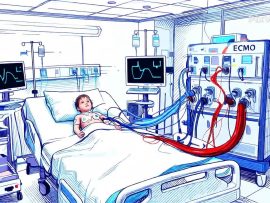
Abstract Background Extracorporeal cardiopulmonary resuscitation (ECPR) is increasingly used for refractory paediatric in-hospital cardiac arrest (IHCA). Although rapid initiation of extracorporeal life support (ECLS) is widely considered critical, the relative..
Read More
Abstract Intraoperative adverse events (IAEs) are a significant unresolved problem in surgery. Breakdown in nontechnical skills (NTS) of surgical team members are a significant contributor to preventable IAEs [], Surgical..
Read More
Abstract Artificial intelligence (AI) has rapidly emerged as a transformative force across multiple scientific and clinical domains, demonstrating remarkable capabilities in data analysis, pattern recognition, and predictive modeling. In the..
Read More
Abstract Background Extracorporeal circulation (ECC) is increasingly supported by biomaterials engineered to minimize chemical leaching, and many biomedical manufacturers have now removed or substantially reduced phthalate plasticizers particularly di(2-ethylhexyl) phthalate..
Read More
Abstract Background Acute kidney injury is a common complication of cardiac surgery and may lead to kidney failure. In a large sample sourced from national registries, we estimated the risk..
Read More
Abstract Introduction Bleeding and clotting phenotypes are common in patients supported with Extracorporeal Membrane Oxygenation (ECMO) and are associated with increased mortality. However, tools to distinguish bleeding from clotting phenotypes..
Read More
Abstract Factor XIII (FXIII) contributes to clot stability and reduces clot susceptibility to lysis through fibrin cross-linking. Standard coagulation tests like prothrombin time and activated partial thromboplastin time do not..
Read More
Abstract Background and Objectives: Overt perioperative stroke remains a feared complication of adult cardiac surgery. Diffusion-weighted magnetic resonance imaging (DWI-MRI) has revealed a more prevalent form of cerebral injury, termed..
Read More
Abstract Decompensated differential carbon dioxide (CO2) removal can occur during spontaneous breathing on peripheral venoarterial extracorporeal membrane oxygenation (V-A ECMO) when a low right radial arterial partial pressure of carbon..
Read More