
Hemoadsorption with the Cytosorb adsorber can effectively reduce cell-free hemoglobin from porcine blood in vitro

Abstract
Objective
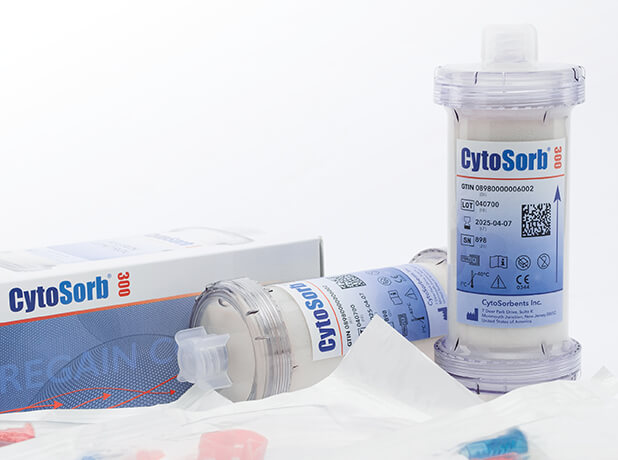
The aim of this study was to investigate the maximum capacity of the Cytosorb adsorber for clearance of cell-free hemoglobin (cfHb) in a porcine cfHb solution in vitro.
Methods
Anticoagulated porcine blood was centrifuged to separate plasma from RBCs. Red blood cell concentrate was stored in the freezer, thawed, and mixed with distilled water to achieve complete hemolysis. The cfHb solution was divided into 12 aliquots of 1,000 mL each. Six test runs were performed in a circular setup with the Cytosorb adsorber. Samples were collected before and after adsorber. After 20 L of processed cfHb solution, the storage bottle was exchanged, and a new storage bottle with 1,000 mL of the cfHb solution with the initial cfHb concentration was processed for another 10 L.
Results
The initial median cfHb concentration of the porcine cfHb solution of 4.13 mmol/L (4.03 to 4.22 mmol/L) decreased to 2.70 mmol/L (2.54 to 2.79 mmol/L) after processing 20 L of cfHb solution. This corresponds to a median cfHb reduction of 22.1 g (21.9 to 27.1 g), which was primarily achieved during the first 10.0 L of processed cfHb solution. In the second storage bottle, no further relevant cfHb concentration decrease was achieved.
Conclusions
Hemoadsorption using the Cytosorb adsorber effectively reduced cfHb concentration from a porcine cfHb solution in vitro. The maximum adsorption capacity of the Cytosorb adsorber for this experimental setup was about 22.1 g.
Clinical Relevance
The Cytosorb adsorber might be a promising tool for removal of cfHb from the circulation in vivo.