


Abstract Due to the similar size ratios, adult porcine models are suitable for cardiovascular and circulatory physiology studies on extracorporeal circulation. As standard, the connection to the cardiopulmonary bypass (CBP)..
Read More
Abstract Objectives To develop a multimodal pediatric critical care datamart supporting predictive modeling and decision support tool development, integrating high-resolution physiologic and clinical data and future clinical deployment. Materials and..
Read More
Abstract In cases of severe cardiopulmonary failure, extracorporeal membrane oxygenation (ECMO) may be temporarily used as a life-saving support for cardiac and/or lung function. Operating under non-physiological flow conditions, characterized..
Read More
Abstract OBJECTIVES Extracorporeal membrane oxygenation (ECMO) is a life-saving therapy for severe cardiopulmonary failure, but structured training remains constrained by costs, logistics, and the absence of validated high-fidelity simulators. This..
Read More
Abstract Introduction Small animal models are indispensable in cardiovascular research. This scoping review aims to provide an overview of contemporary rat models for extracorporeal life support (ECLS) after global ischaemia...
Read More
Abstract Objective: To evaluate whether systemic anticoagulation therapy affects the survival of adult patients receiving venovenous extracorporeal membrane oxygenation (VV-ECMO) for acute respiratory distress syndrome (ARDS). Design: Multicenter retrospective study...
Read More
Abstract Introduction Regardless of its effectiveness, veno-arterial extracorporeal membrane oxygenation (VA-ECMO) support is not a risk-free method. Its use is associated with high complication and mortality rates, especially in patients..
Read More
Abstract Objectives This study describes a single-institution experience of adult patients supported with multiple runs of extracorporeal membrane oxygenation (ECMO) during the same hospitalization. We aim to assess complication and..
Read More
Abstract Extracorporeal cardiopulmonary resuscitation (ECPR) using venoarterial extracorporeal membrane oxygenation (VA ECMO) is a life-saving intervention for selected patients in refractory cardiac arrest. Given the procedure’s technical complexity and time-critical..
Read More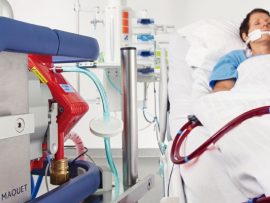
Abstract Venoarterial extracorporeal membrane oxygenation (VA-ECMO) offers cardiopulmonary support with the tradeoff of increased left ventricular (LV) afterload and its adverse sequelae. LV decompression strategies include the use of intra-aortic..
Read More
Abstract Background Fulminant myocarditis is a severe cardiac condition characterized by rapid progression and high mortality. In recent years, advancements in medical technology, particularly the application of mechanical circulatory support,..
Read More
Abstract Background For patients presenting with cardiogenic shock due to acute myocardial ischaemia, veno-arterial extracorporeal membrane oxygenation (ECMO) is often the only potential lifesaving intervention remaining when revascularisation does not..
Read More
Abstract SEVERE HEMOPTYSIS REMAINS A significant medical emergency, often requiring a multidisciplinary approach to identify the bleeding source and implement effective treatment. Airway obstruction due to clots secondary to massive..
Read More
Abstract Background Extracorporeal membrane oxygenation (ECMO) has emerged as a crucial modality in managing severe cardiac and respiratory failure; however, nosocomial infections and complex antimicrobial prescribing challenges may accompany its..
Read More
Abstract Despite significant advancements in critical care practice and extracorporeal technology, refractory hypoxia remains a persistent clinical challenge during extracorporeal membrane oxygenation (ECMO). To demonstrate a systematic, algorithmic pathway for..
Read More
Abstract Objective(s) To evaluate survival outcomes and identify candidate profiles for venoarterial extracorporeal membrane oxygenation in adult patients with sepsis-induced cardiomyopathy. Design The authors systematically searched PubMed, Embase, and Google..
Read More
Abstract Background: Veno-arterial ExtraCorporeal Membrane Oxygenation (V-A ECMO) as a bridge to recovery or long-term assist devices in severe cardiocirculatory failure typically lasts 5-7 days. There is scarce guidance on..
Read More
Abstract INTRODUCTION Unfractionated heparin (UFH) is the most commonly used anticoagulant during extracorporeal membrane oxygenation (ECMO) (1). However, UFH also has several limitations: (i) it requires individualized dosing and close..
Read More
Abstract Introduction Veno-venous extracorporeal membrane oxygenation (VV ECMO) is a life-sustaining technology that supports patients with severe acute respiratory failure. Indications and contraindications to VV ECMO are evolving and professional..
Read More
Abstract Extracorporeal membrane oxygenation (ECMO) may be a life-saving intervention for patients with respiratory or cardiac failure or cardiac arrest. Storing wet-preprimed ECMO circuits can reduce the time to initiate..
Read More
Abstract Extracorporeal membrane oxygenation (ECMO) provides temporary support for patients with severe acute cardiac or respiratory failure. Although thrombotic complications are common during ECMO, the real-time detection and management of..
Read More
Abstract Introduction Extracorporeal membrane oxygenation (ECMO) is a high-risk, low-frequency intervention requiring specialized training and effective teamwork, for which simulation-based training is a valuable tool. Across medical disciplines escape room-style..
Read More
Abstract Background Venoarterial extracorporeal membrane oxygenation (VA-ECMO) is increasingly utilised in critically ill patients with severe cardiac failure and cardiac arrest, yet sex-specific differences in presentation, utilisation, and clinical outcomes..
Read More
Abstract Acute respiratory distress syndrome (ARDS) in pregnancy is rare but life-threatening. Extracorporeal membrane oxygenation (ECMO) has been used as rescue therapy in refractory cases, though evidence remains limited. This..
Read More
Abstract Background Indirect calorimetry (IC) in patients receiving extracorporeal membrane oxygenation (ECMO) is complicated. This study presents a novel IC method for this population and compares energy expenditure (EE) from..
Read More
Abstract Background ECMO-associated coagulopathy is a common phenomenon in patients undergoing ECMO therapy. However, data on coagulation trajectories in the post ECMO decannulation period are limited. This study aimed to..
Read More
Abstract Objectives Exploratory laparotomy, when required as a treatment for abdominal complications of post–extracorporeal membrane oxygenation (ECMO) initiation, carries a high mortality rate that approaches 80% to 100%. However, studies..
Read More
Abstract Background: Temporary mechanical circulatory support (t‑MCS) is increasingly used in fulminant myocarditis (FM), yet long‑term outcomes and risk factors remain poorly defined. Methods: From the FULLMOON international cohort..
Read More
Abstract Objective: Extracorporeal membrane oxygenation (ECMO) has been used to provide pulmonary and circulatory support in patients with ongoing critical illness. Studies investigating whether an association exists between ECMO center-volume..
Read More
Abstract Background: Harlequin syndrome, also referred to as differential hypoxemia or North South syndrome, is a critical yet underrecognized complication of venoarterial extracorporeal membrane oxygenation and hybrid configurations such as ECpella...
Read More