
Discover our section specialized in congenital heart disease pathologies, where you can find more than 200 pathologies.
Collaboration with Prof. Daniel Tobler and University of Basel


Taussig-Bing anomaly is a rare congenital heart malformation that was first described in 1949 by Helen B. Taussig (1898–1986) and Richard J. Bing (1909–). Although substantial improvement has since been achieved in surgical results of the repair of the anomaly, management of the Taussig-Bing anomaly remains challenging. A history of..
Read More

Double outlet right ventricle (DORV) is a heterogeneous group of abnormal ventriculoarterial connections where, by definition, both great arteries (pulmonary artery and aorta) arise primarily from the morphologically right ventricle. This condition affects 1-1.5% of the patients with congenital heart diseases, with a frequency of 1 in each 10,000 live..
Read More
Double-outlet right ventricle (DORV) and subaortic ventricular septal defect (VSD) is defined anatomically as a defect where the entire pulmonary trunk and at least half of the aorta arises from the right ventricle (RV) and the VSD is most closely aligned with the aorta. The surgical management of DORV and..
Read More
The clinical, hemodynamic, angiocardiographic and pathologic findings are presented in an infrequent but surgically correctable type of double outlet right ventricle. This study is based on six cases, one with autopsy confirmation. In all, the viscera and atria were in situs solitus (S). A ventricular d-loop was present (D). There..
Read More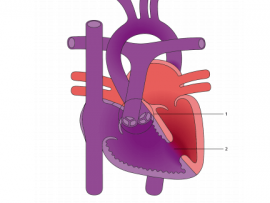
Since Kirklin described the first successful correction of double-outlet right ventricle (DORV), surgical repair has been extended to more complex forms of the malformation . In 1972, Lev and Bharati introduced their classification according to the anatomic position of the VSD as related to the arterial trunks . The term ‘non-committed’ (or..
Read More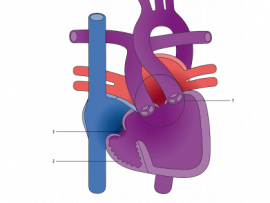
Double-outlet left ventricle (DOLV) is a rare congenital cardiac malformation in which both great arteries originate entirely or predominantly from the morphologic left ventricle. DOLV occurs most commonly in the form of atrial situs solitus with atrioventricular (AV) concordance. Ventricular septal defect (VSD) is most commonly subaortic, and 90% of..
Read More
Double outlet right ventricle (DORV) is a rare congenital heart defect, meaning it’s a condition a baby is born with. In DORV, the pulmonary artery and the aorta — the heart’s two major arteries — both connect to the right ventricle. In a normal heart, the pulmonary artery connects to..
Read More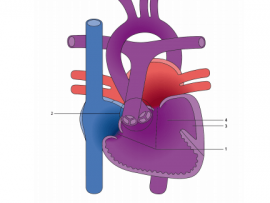
Double outlet right ventricle (DORV) is a . There is a malformation of the fetus heart in the womb leading to the right ventricle that has the two major arteries, namely the aorta and pulmonary artery arising from it.
Read More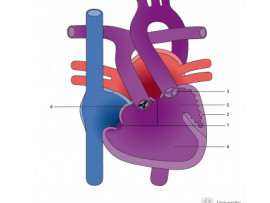
Double inlet left ventricle (DILV) is a heart defect that is present from birth (congenital). It affects the valves and chambers of the heart. Babies born with this condition have only one working pumping chamber (ventricle) in their heart.
Read More