


Central and Mixed Venous Oxygen Saturation in Cardiac Surgery: A Systematic Review and Meta-analysis
Abstract Central venous oxygen saturation (ScvO2) and mixed venous oxygen saturation (SvO2) are widely used markers of tissue perfusion. Their role in cardiac surgery remains uncertain. This study conducted a..
Read More
Abstract Perioperative bleeding remains a major complication in cardiac surgery and is associated with increased morbidity, mortality, and transfusion requirements. While patient blood management strategies and goal-directed hemostatic therapies have..
Read More
Abstract As ECMO continues to grow beyond the CVOR, a growing number of physicians outside cardiac surgery are being asked to cannulate. This expansion is an important step toward building..
Read More
Abstract Background The use of extracorporeal membrane oxygenation (ECMO) has expanded for severe respiratory and circulatory failure. Acute kidney injury (AKI) is one of the most frequent complications. Up to..
Read More
Abstract Background Postoperative recovery in older adults undergoing cardiac surgery is a complex and multidimensional process associated with clinical, psychological, and nutritional factors; however, these factors are often addressed separately..
Read More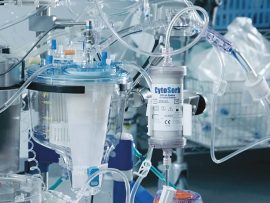
Abstract Background This systematic review and meta-analysis evaluated the clinical efficacy and safety of hemoperfusion in adults receiving extracorporeal membrane oxygenation (ECMO). Methods We systematically searched PubMed, Embase, the Cochrane..
Read More
Abstract Objective To evaluate the relationship between cardiopulmonary bypass (CPB) duration, change in thoracic fluid content (ΔTFC) measured using electrical cardiometry, and postoperative oxygenation in infants undergoing ventricular septal defect..
Read More
Abstract Imagine, for a moment, that targeted temperature management (TTM), the standard of care in post cardiac arrest management for more than two decades, was built on a false premise..
Read More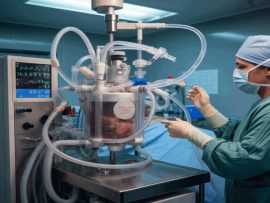
Abstract Objective Aortic arch surgery remains a complex procedure associated with significant morbidity and mortality. This review aims to provide insights into the current concepts and evidence regarding organ protection..
Read More
Abstract Objectives Antegrade cerebral perfusion (ACP) is used to protect the brain during aortic arch reconstructions. It is unknown whether cerebral autoregulation remains intact during ACP. This study was designed..
Read More
Abstract Cardiac arrest is a leading cause of global mortality, with low survival rates despite advances in resuscitation science. Reported survival ranges from 8% to 34% for out-of-hospital and in-hospital..
Read More
Abstract Mechanical stimulation can remodel the physiological mechanical microenvironment of cardiomyocytes and influence their maturation and injury progression. However, the dynamic process by which cardiomyocytes transition from adaptive maturation to..
Read More
Abstract Over the past 2 decades, liver transplantation (LT) has undergone a profound transformation in different fields. In particular, once characterized by massive blood product utilization, LT is now characterized..
Read More
Abstract Background: Establishing the Korean Pediatric and Congenital Heart Surgery Database (KPCHSD) and linking it to the World Database for Pediatric and Congenital Heart Surgery (WDPCHS) is an important step..
Read More
Abstract Objectives Aortic arch surgery traditionally relies on hypothermic circulatory and cardioplegic arrest, exposing myocardium and visceral organs to ischaemia-reperfusion injury. We developed a total body perfusion (TBP) strategy providing..
Read More
Abstract Objectives Extracorporeal Membrane Oxygenation (ECMO) is associated with high risks of bleeding and clotting. While traditional anticoagulants like heparin and bivalirudin target the coagulation cascade, prostaglandins including PGE1 and PGI2 may..
Read More
Abstract Objectives Postoperative atrial fibrillation is common after cardiac surgery. Effective preventative measures are lacking, partly due to an incomplete understanding of its pathogenesis. Inflammation is a major contributor to..
Read More
Abstract Objectives Inadequate heparin response is frequently observed in neonates and young infants. While low antithrombin level is considered to be the primary cause, the existing literature suggests that it..
Read More
Abstract Background: Extracorporeal membrane oxygenation (ECMO) candidacy decisions for children with respiratory failure can be variable among pediatric critical care attending physicians, and prior studies showed that baseline functional status..
Read More
Abstract Objectives To determine the prevalence of iron deficiency and iron deficiency anemia and their association with adverse outcomes in children undergoing cardiac surgery with cardiopulmonary bypass. Design Retrospective review...
Read More
Abstract Background Patients with hypertrophic obstructive cardiomyopathy (HOCM) undergoing minimally invasive modified Morrow procedure may be vulnerable to postoperative pulmonary dysfunction. During cardiopulmonary bypass (CPB), lung-protective ventilation has been proposed,..
Read More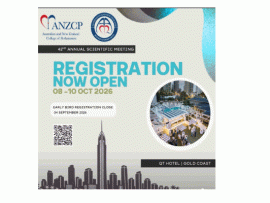
Gold Coast, Queensland 8-10 October, 2026 The Australian and New Zealand College of Perfusionists (ANZCP) warmly invites submissions for the 2026 Annual Scientific Meeting, to be held at QT Gold Coast, Queensland,..
Read More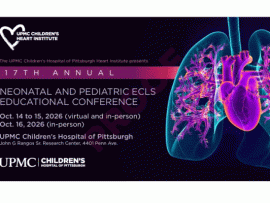
17th Annual Neonatal and Pediatric ECLS Educational Conference. The CHP ECMO Conference is an educational event offered both in person and virtually. The program brings together multidisciplinary experts to discuss..
Read More
Abstract Extracorporeal membrane oxygenation (ECMO) is an established life-saving therapy for severe acute respiratory distress syndrome and cardiogenic shock, yet it profoundly alters cardiopulmonary physiology and challenges conventional hemodynamic monitoring...
Read More
Abstract Adult venoarterial extracorporeal membrane oxygenation (VA ECMO) is a costly life support therapy, where patient selection remains a significant hinge-point in determining patient outcomes. Despite this, few sites have..
Read More
Abstract Objectives Minimally invasive mitral valve surgery (MIV-MVS) continues to evolve through refinements in surgical technique and perioperative management. This study evaluated the association between arterial cannulation strategy and perioperative..
Read More
Abstract Objectives We investigated the effects of the combined use of preoperatively separated autologous red blood cells, plasma, and fibrin sealant on reducing allogeneic blood transfusion during valve-sparing root replacement..
Read More
Abstract Acute limb ischemia (ALI) remains one of the most common complications of peripheral veno-arterial extracorporeal membrane oxygenation (V-A ECMO). Across heterogeneous cohorts, reported ALI rates vary widely (≈8–30% and..
Read More
Abstract Peripheral venoarterial extracorporeal membrane oxygenation (VA-ECMO) and minimally invasive cardiac surgery often require femoral arterial cannulation, wherein lower limb ischemia remains a major complication. Although introducer sheaths with side..
Read More
Abstract Background Cerebral hemodynamic disturbances are common in neonates receiving extracorporeal membrane oxygenation (ECMO), yet systematic data describing changes in cerebral hemodynamics during ECMO support remain limited. This study was..
Read More