
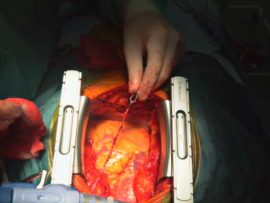

Abstract Essentials Strategies to improve platelet function may reduce excessive bleeding during cardiac surgery. Patients were randomized to standard care or standard care + noradrenaline infusion. Low‐dose noradrenaline improved intraoperative..
Read More
Abstract Perfusion strategies for have direct consequences on pediatric cardiac surgery outcomes. However, inconsistent study results and a lack of uniform evidence-based guidelines for pediatric cardiopulmonary bypass management have led to..
Read More
Abstract Background During cold storage, some red blood cell (RBC) units age more rapidly than others. Yet, the Food and Drug Administration has set a uniform storage limit of 42..
Read More
Abstract Background and Aim of the Study Extracorporeal life support (ECLS) may be necessary in refractory postcardiotomy cardiogenic shock (PCS) unresponsive to optimal medical treatment. We sought to analyze the..
Read More
Abstract Central venoarterial extracorporeal membrane oxygenation has been used since the 1970s to support patients with cardiogenic shock following cardiac surgery. Despite this, in-hospital mortality is still high, and although..
Read More
Abstract Objectives Our aim was to describe the pharmacokinetics of cefazolin in paediatric patients undergoing cardiac surgery with cardiopulmonary bypass (CPB) who received cefazolin for peri-operative surgical prophylaxis in addition..
Read More
Abstract Summary We investigated microcirculatory perfusion disturbances following cardiopulmonary bypass in the early postoperative period and whether the course of these disturbances mirrored restoration of endothelial glycocalyx integrity. We performed..
Read More
Abstract Pediatric cardiac surgical patients are at particular risk for post-cardiopulmonary bypass hemorrhage. Moreover, both the incidence and volume of have been associated with increased morbidity in pediatric cardiac patients. Transfusion..
Read More
Abstract Extracorporeal membrane oxygenation is a rapidly emerging treatment for respiratory or cardiac failure and is used as a bridge to recovery, transplant, or destination therapy. Adult patients receiving extracorporeal..
Read More
Abstract Background The predictors and independent outcome association of after cardiac surgery are important and yet poorly characterised. Methods We performed a retrospective of cardiac surgery patients between January 2009 and March..
Read More
Abstract Background: Administering isoflurane 2.5% into the oxygenator during cardiopulmonary bypass results in no patient movement. However, doing so may result in an excessive depth of anaesthesia particularly, when hypothermia..
Read More
Abstract Legionella community–acquired pneumonia necessitating veno-venous extracorporeal membrane oxygenation for severe acute respiratory distress syndrome has been reported in adults. However, few options remain in cases of refractory hypoxemia on..
Read More
Abstract Background Venoarterial (VA) (ECMO) application in postcardiotomy shock (PCS) and non-PCS is increasing. VA-ECMO plays a critical role in the management of these patients, yet may be associated with serious..
Read More
Abstract Objective induces degradation of . The authors hypothesized that inflammation is an important determinant of glycocalyx degradation in patients undergoing cardiac surgery with (CPB). Design A prospective . Setting Operation theater and..
Read More
Case 1 A 78-year-old male diabetic patient underwent elective coronary artery bypass grafting (CABG). His insulin therapy had been changed recently to human insulin (Humulin M3; Eli Lilly Italia, Sesto..
Read More
Abstract Objectives To determine whether precardiopulmonary bypass (CPB) normalization of levels in infants to 100% improves heparin sensitivity and during CPB and has beneficial effects into the . Design Randomized, double-blinded, placebo-controlled prospective..
Read More
Abstract Background Arginine vasopressin (AVP) is a naturally occurring peptide with diverse effects mediated through selective V1 and V2 receptors. About 10% of patients undergoing cardiopulmonary bypass develop postoperative vasodilatory..
Read More
Abstract The objective of this study is to establish reliable markers for mortality in children with refractory cardiogenic shock who underwent extracorporeal membrane oxygenation. A retrospective observational cohort study was..
Read More
Abstract Background Despite concern that cardiac surgery may adversely affect cognition, little evidence is available from population-based studies using presurgery data. With the use of the Health and Retirement Study,..
Read More
OBJECTIVES Cardioplegia is the primary method for myocardial protection during cardiac surgery. We conducted a systematic review of randomized controlled trials of cardioplegia in children to evaluate the current evidence..
Read More
Summary Thromboelastometry point‐of‐care coagulation testing facilitates optimised management of bleeding. Previous thromboelastometry systems required the blood sample and liquid reagents to be pipetted in several manual steps by trained personnel...
Read More
Abstract Introduction: We have been developing a closed-circuit cardiopulmonary bypass (CPB) system (“Dihead CPB”) for application during coronary artery bypass grafting (CABG) and valve surgery. To strive for minimal hemolysis..
Read More
Abstract Pump thrombosis and stroke are serious complications of left ventricular assist device (LVAD) support. The aim of this study was to test the ability of an accelerometer to detect..
Read More
Abstract Systemic anticoagulation is a standard of care in adult patients supported by extracorporeal membrane oxygenation (ECMO) to prevent circuit thrombosis and subsequent thromboembolic events. Unfractionated heparin has long been..
Read More
POSTOPERATIVE PULMONARY dysfunction, a known complication after cardiac surgery, is associated with significant morbidity and mortality. Pulmonary complications include hypoxemia; increased work of breathing; atelectasis; pneumonia; and in 2% to..
Read More
Abstract Aim To assess the use of (ECPR), compared with manual or mechanical cardiopulmonary resuscitation (CPR), for (OHCA) and in-hospital cardiac arrest (IHCA) in adults and children. Methods The PRISMA guidelines were..
Read More
Abstract We currently perform open-heart procedures using bloodless priming of cardiopulmonary bypass circuits regardless of a patient’s body weight. This study presents results of this blood-saving approach in neonates and..
Read More
Abstract Despite the advantages of extracorporeal membrane oxygenation (ECMO), secondary catheter infection remains a major concern during ECMO support. In this study, to clarify the mechanism of ECMO catheter-related infection, we evaluated the..
Read More
Abstract is associated with impairment of cardiovascular, pulmonary, gastrointestinal, and renal physiology with significant perioperative consequences and has been linked with higher morbidity and mortality after cardiac surgery. Cardiac surgery..
Read More
Abstract Background: Left ventricular (LV) afterload increase with protracted aortic valve (AV) closure may represent a complication of veno-arterial extracorporeal membrane oxygenation (V-A ECMO). The aim of the present study..
Read More