


Abstract Objectives The (COVID-19) pandemic has been associated with cases of refractory (ARDS) sometimes requiring support with (ECMO). can be used for in patients on ECMO support, but its efficacy and safety in patients with..
Read More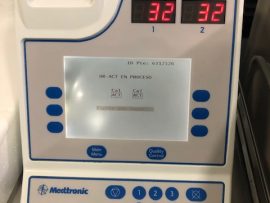
Abstract Objective Bleeding and thrombosis are common complications during Extracorporeal Membrane Oxygenation (ECMO) support for COVID-19 patients. We sought to examine the relationship between inflammatory status, coagulation effects, and observed..
Read More
Abstract We report a case of Kounis syndrome that led to shock after protamine administration during percutaneous coronary intervention (PCI). A man in his 50s was admitted to the nearest..
Read More
Abstract Postpartum hemorrhage (PPH) can lead to substantial blood loss that compromises maternal hemodynamic stability and consequently cause severe maternal complications such as organ dysfunction or death. Intraoperative cell salvage..
Read More

Patient with previous bentall operation undergone redo bentall with valve preservation and tubular graft replacement and SVG redo done weaned from CPB uneventfully you can also see 3D VRT CTA..
Read More

Abstract Background Accurate, pragmatic risk stratification for postoperative delirium (POD) is necessary to target preventative resources toward high-risk patients. Machine learning (ML) offers a novel approach to leveraging electronic health..
Read More
Abstract Background Patients with (COVID-19)-related (ARDS) increasingly receive (ECMO) support. While ECMO has been shown to increase risk of stroke, few studies have examined this association in COVID-19 patients. Objective We conducted a..
Read More
Abstract that can contribute to abnormal bleeding can have a detrimental effect during cardiac surgery. Patients who are known to have such pathologies should be investigated thoroughly and cautious measures..
Read More
Abstract Objective One of the steps of the Surgical Safety Checklist is for the team members to introduce themselves. The objective of this study was to implement a tool to..
Read More
Abstract The dramatic increase in the use of extracorporeal membrane oxygenation (ECMO) over the last decade with the concomitant need for ECMO competent perfusionists has raised questions of how well..
Read More
Abstract Secondary mitral valve regurgitation is a frequent consequence of left ventricular dysfunction in patients with severe heart failure. The management of this disease can be challenging since it often..
Read More
Abstract Circulatory arrest and left heart bypass are the most common approaches to manage perfusion during distal arch surgery. We report a novel perfusion technique utilized in the treatment of..
Read More
Abstract There are quarter of a million articles in PubMed since the wake of the COVID-19 pandemic with about fifteen hundred articles on extracorporeal membrane oxygenation (ECMO) alone. Those that are entrenched..
Read More
Abstract Objectives The purpose of this study was to assess changes in cardiovascular disease severity, types, postoperative complications and prognosis during the COVID-19 pandemic and to explore possible influencing factors...
Read More
Abstract Objective To report maternal outcomes in a cohort of women who received autotransfusion of vaginally shed blood and to describe the feasibility of blood collection and cell salvage processing..
Read More

Nossa 1º aulão de 2022!! Prof. Elio Carvalho irá explicar no que este canal irá se transformar!!! Prof. Elio Carvalho é Biomédico, Microbiologista e Perfusionista pela Unicamp, CLAP e SBCEC...
Read More
Abstract Objectives: Few data exist on the use of del Nido cardioplegia in adults, specifically during operations requiring prolonged aortic cross-clamp. In this pilot study, we evaluate outcomes of patients undergoing..
Read More
Abstract Introduction Despite being a daily clinical application in cardiac operating theaters, an evidence-based approach on how to optimally initiate the heart–lung machine (HLM) to prevent critical phases of cerebral..
Read More
Patient with severe AS and high gradient undergone AVR with biological valve. Dr.Sam Zeraatian Nejad Davani, CEO of rockingham medical research ADKWA center as well as Head of IUMS transplant..
Read More
Abstract Background Venoarterial extracorporeal membrane oxygenation (ECMO) provides mechanical support for critically ill patients with cardiogenic shock. Typically, the size of the arterial return cannula is chosen to maximize flow...
Read More
Abstract Peripheral venoarterial extracorporeal membrane oxygenation (VA ECMO) for acute cardiac failure reestablishes normal oxygen delivery and perfusion. However, VA ECMO can be limited by insufficient ventricular unloading, resulting in..
Read More
This case reports on a 58-year-old male patient who presented to the hospital for an elective cardiothoracic surgical procedure. [pdf-embedder url="https://perfusfind.com/wp-content/uploads/2021/12/CoW_06_2022_E_web_compressed.pdf"]
Read More
Abstract We read with great interest the paper of Giani and colleagues titled "Prone positioning during venovenous extracorporeal membrane oxygenation for acute respiratory distress syndrome: a pooled individual patient data..
Read More
Abstract Perfusion education programs use simulation to provide students with clinical skills prior to entering the operating room. To teach the psychomotor execution of skills in a simulation lab requires..
Read More
Abstract Objectives To examine the (PK) and of a tranexamic (TXA) regimen designed for cardiac surgery with (CPB). Design A pilot study quantifying TXA concentrations, markers, and a plasmin- generation (PG) assay. For comparison,..
Read More
Abstract Respiratory failure caused by severe acute respiratory syndrome coronavirus-2 (SARS-CoV-2) is associated with mortality. Patients unresponsive to conventional therapy may benefit from temporary venovenous extracorporeal membrane oxygenation (VV-ECMO). We..
Read More