


Abstract Background Optimal oxygenation strategies during cardiopulmonary bypass (CPB) in children with cyanotic congenital heart disease remain controversial. Although hyperoxia has traditionally been used to compensate for chronic hypoxemia, concerns..
Read More
Abstract Objective To evaluate the effects of cardiopulmonary bypass (CPB) on peripheral white blood cell counts, neutrophil surface marker expression, and neutrophil function by comparing patients undergoing on-pump CABG (ONCAB)..
Read More
Abstract Background Arterial cannulation during cardiopulmonary bypass (CPB) significantly alters native aortic hemodynamics by generating a high-velocity jet that interacts with the ascending aorta and aortic arch geometry. These flow..
Read More
Abstract Background Allogeneic blood is a limited and globally scarce resource. Protocols based on the Patient Blood Management (PBM) program, incorporating therapeutic alternatives to reduce the use of red blood..
Read More
Abstract Background Biomarkers play a crucial role in the preoperative assessment for cardiac surgery, aiding in risk stratification and evaluating comorbid diseases. Objective This narrative review summarizes current evidence on..
Read More
Abstract Cardiovascular surgery has substantially improved survival and quality of life for patients with cardiovascular disease, yet contemporary surgical populations are increasingly older, multimorbid, and affected by advanced disease, rendering..
Read More
Abstract Background While hyperoxia has conventionally been the standard during cardiopulmonary bypass (CPB) to prevent hypoxemia, recent concerns regarding oxygen-induced oxidative stress have sparked debate over whether a normoxic strategy..
Read More
Introduction Here, we present a case of forme fruste (incomplete) cor triatriatum dexter (ff-CTD), an incidental finding on pre–cardiopulmonary bypass (CPB) transesophageal echocardiography (TEE) that prevented appropriate venous cannulation, leading..
Read More
Abstract Introduction: Providing sufficient organ perfusion during cardiopulmonary bypass (CPB) is a common research topic among extracorporeal technology researchers. The application of an elevated cardiac index (CI) to enhance CPB..
Read More
Abstract An imbalance between the classical and alternative renin-angiotensin system (RAS) is a characteristic feature of the multifactorial pathophysiology responsible for vasodilatory shock and provides a rationale for its treatment..
Read More
Abstract Background Ultrafiltration is integral to cardiopulmonary bypass, yet the optimal replacement fluid for zero-balance ultrafiltration requires further investigation to guide clinical practice. This study aimed to compare the efficacy..
Read More
Abstract Heparin-induced thrombocytopenia (HIT) is an immune-mediated adverse drug reaction characterized by thrombocytopenia and a high risk of thrombosis. Patients with HIT and a need for cardiac surgery with cardiopulmonary..
Read More
Abstract Background Platelet activation is crucial for hemostasis and thrombosis, particularly in patients on antiplatelet therapy. Managing bleeding risk during cardiac surgery requires understanding platelet dynamics, especially when antiplatelet agents..
Read More
Abstract Background and Aims Adults with congenital heart disease tend to develop both cardiac and noncardiac age-related comorbidities earlier in life than the general population, suggesting accelerated biological ageing. Epigenetic..
Read More
Abstract Background An abnormal perioperative blood lactate level has been reported to be associated with poor outcomes after cardiac surgery. However, their impact on female patients remains underexplored. This large-scale..
Read More
Abstract Introduction Cardiac surgery with cardiopulmonary bypass (CPB) induces extreme disturbances in physiological homeostasis, which may trigger vaso‑occlusive crises and hemolysis in patients with sickle cell disease (SCD). The aim..
Read More
Abstract Background We sought to describe trends and outcomes of mechanical circulatory support (MCS) use in acute myocardial infarction and cardiogenic shock (AMI-CS) patients undergoing coronary artery bypass grafting (CABG)...
Read More
Abstract Background In patients receiving extracorporeal membrane oxygenation (ECMO), standard practice is full-dose intravenous unfractionated heparin (UFH) targeting an activated partial thromboplastin time of 2·0–2·5 times baseline to reduce thrombotic..
Read More
Abstract Background This study aims to assess the agreement between noninvasive hemoglobin (SpHb) and invasive hemoglobin (InvHb) monitoring in guiding blood transfusions during thoracic procedures. Methods This study was not..
Read More
Abstract In the course of extracorporeal circulation (ECC), real-time monitoring of blood electrolyte levels is crucial for ensuring patient safety and improving outcomes. A continuous detection chip of blood electrolytes..
Read More
Abstract The evolution of perioperative care in cardiac surgery is uniquely captured by the 2 paradigms that define its modern history: fast-track recovery and Enhanced Recovery After Surgery (ERAS) ()...
Read More
Abstract Purpose Obesity is increasingly encountered among patients requiring extracorporeal membrane oxygenation (ECMO) for severe respiratory or cardiac failure. It alters respiratory and cardiovascular physiology and drug pharmacokinetics and introduces..
Read More
Abstract Objectives Pulmonary dysfunction is a known complication of cardiac surgery. High fractions of inspired oxygen (FiO2) during the critical pulmonary reperfusion phase of cardiopulmonary bypass (CPB) weaning is a..
Read More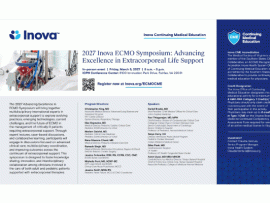
The 2027 ECMO Symposium: Advancing Excellence in Extracorporeal Life Support will convene multidisciplinary experts to address emerging evidence, evolving technologies, and systems-based strategies influencing contemporary VA and VV ECMO practice...
Read More
Abstract Background Cardiac surgery is associated with significant mortality and complication risks. This study aims to develop an interpretable machine learning (ML) model to predict adverse outcomes (AOs) after cardiac..
Read More
Abstract Background Fluid administration, priming solutions, and the use of cardiopulmonary bypass (CPB) during cardiac surgery are likely to promote hemodilution and inflammatory responses, leading to microcirculatory impairment. A new..
Read More
Abstract Background Acute kidney injury (AKI) is a common complication following cardiac surgery. The RCR (ratio of RDW to total serum calcium (TSC)), which exhibits high predictive value for various..
Read More
Abstract Objectives To identify risk factors associated with inadequate heparin response in pediatric congenital heart surgery requiring cardiopulmonary bypass and to develop age-specific predictive scoring systems. Design Retrospective cohort study...
Read More
Abstract Background Heparin-induced thrombocytopenia rules out the possibility of adopting heparin for cardiopulmonary bypass. To overcome this problem two anticoagulants can be used: argatroban and bivalirudin. Case presentation We report..
Read More
Abstract Background Despite the widespread use of retrograde cardioplegia in most institutions, some surgeons continue to encounter technical difficulties during insertion of the retrograde cardioplegia cannula. We introduce the 4-finger..
Read More