


A rare type of congenital heart disease is an interrupted aortic arch (IAA), which affects approximately 1.5% of congenital heart disease patients. Interrupted aortic arch is an anomaly that can..
Read More
A rare type of congenital heart disease is an interrupted aortic arch (IAA), which affects approximately 1.5% of congenital heart disease patients. Interrupted aortic arch is an anomaly that can..
Read More
A rare type of congenital heart disease is an interrupted aortic arch (IAA), which affects approximately 1.5% of congenital heart disease patients. Interrupted aortic arch is an anomaly that can..
Read More
A rare type of congenital heart disease is an interrupted aortic arch (IAA), which affects approximately 1.5% of congenital heart disease patients. Interrupted aortic arch is an anomaly that can..
Read More
A rare type of congenital heart disease is an interrupted aortic arch (IAA), which affects approximately 1.5% of congenital heart disease patients. Interrupted aortic arch is an anomaly that can..
Read More
Interrupted (IAA) is an extremely rare CHD defined as the loss of luminal continuity between the . Its clinical presentation, including , , or severe CHF in the first 2 weeks of life, is..
Read More

Common arterial trunk (CAT), or truncus arteriosus, is a rare form of cyanotic congenital heart disease and is highly associated with DiGeorge syndrome (microdeletion 22q11.2). Prenatal diagnosis is highly feasible,..
Read More
Eisenmenger syndrome is the most severe form of pulmonary arterial hypertension and arises on the basis of congenital heart disease with a systemic-to-pulmonary shunt. Due to the chronic slow progressive..
Read More
Development of Eisenmenger syndrome in a known patient of patent ductus arteriosus (PDA) is easy by carefully looking for differential cyanosis and clubbing in upper and lower limbs. It is..
Read More
Eisenmenger syndrome (ES) is a constellation of symptoms that arise from a congenital heart defect and result in large anatomic shunts. Due to anatomic variations present at birth, hemodynamic forces..
Read More
Atrial septal defect (ASD) may be rarely associated with Eisenmenger syndrome (ES), the most advanced form of pulmonary vascular disease to complicate a congenital heart disease. In spite of availability..
Read More
An aortopulmonary (AP) window is a rare cause of Eisenmenger syndrome and results from an abnormal septation of the truncus arteriosus [1]. Most such defects present with early onset congestive heart failure during infancy and adult..
Read More
The Ebstein's anomaly is a malformation of the tricuspid valve, in which the septal and posterior leaflets are attached to the wall of the right ventricle. The usual association is with an atrial septal defect, followed..
Read More
A malformed heart valve that does not properly close to keep the blood flow moving in the right direction. Blood may leak back from the lower to upper chambers on..
Read More
Ebstein’s anomaly is a rare congenital heart disorder occurring in ≈1 per 200 000 live births and accounting for <1% of all cases of congenital heart disease. This anomaly was described..
Read More
Mitral valve dysplasia syndrome is a unique form of congenital heart disease with severe aortic stenosis but normal or enlarged left ventricle secondary to primary mitral valve disease. Increased left..
Read More
Transposition of the great arteries (TGA) is a pediatric cardiac congenital defect arising from an embryological discordance between the aorta and pulmonary trunk. During cardiac development, the conotruncal septum spirals..
Read More
Taussig-Bing anomaly is a rare congenital heart malformation that was first described in 1949 by Helen B. Taussig (1898–1986) and Richard J. Bing (1909–). Although substantial improvement has since been..
Read More

Double outlet right ventricle (DORV) is a heterogeneous group of abnormal ventriculoarterial connections where, by definition, both great arteries (pulmonary artery and aorta) arise primarily from the morphologically right ventricle...
Read More
Double-outlet right ventricle (DORV) and subaortic ventricular septal defect (VSD) is defined anatomically as a defect where the entire pulmonary trunk and at least half of the aorta arises from..
Read More
The clinical, hemodynamic, angiocardiographic and pathologic findings are presented in an infrequent but surgically correctable type of double outlet right ventricle. This study is based on six cases, one with..
Read More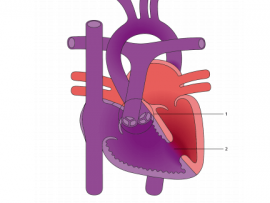
Since Kirklin described the first successful correction of double-outlet right ventricle (DORV), surgical repair has been extended to more complex forms of the malformation . In 1972, Lev and Bharati introduced..
Read More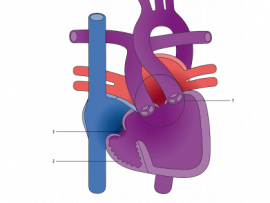
Double-outlet left ventricle (DOLV) is a rare congenital cardiac malformation in which both great arteries originate entirely or predominantly from the morphologic left ventricle. DOLV occurs most commonly in the..
Read More
Double outlet right ventricle (DORV) is a rare congenital heart defect, meaning it’s a condition a baby is born with. In DORV, the pulmonary artery and the aorta — the..
Read More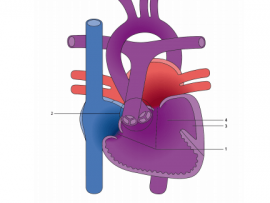
Double outlet right ventricle (DORV) is a . There is a malformation of the fetus heart in the womb leading to the right ventricle that has the two major arteries, namely..
Read More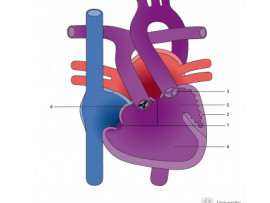
Double inlet left ventricle (DILV) is a heart defect that is present from birth (congenital). It affects the valves and chambers of the heart. Babies born with this condition have..
Read More