


Abstract Both overfeeding and underfeeding critically ill children are problematic. This prospective pilot study evaluated the resting energy expenditure in infants and children requiring extracorporeal membrane oxygenation (ECMO) support. An..
Read More
Abstract Background The optimal strategy of weaning veno-arterial (V-A) extracorporeal membrane oxygenation (ECMO) remains poorly described. Pump-controlled retrograde trial off (PCRTO) involves serial decremental pump revolutions until a retrograde flow..
Read More
Over the last two years, Extracorporeal Membrane Oxygenation (ECMO) has emerged as a therapy for COVID-related Acute Respiratory Distress Syndrome (ARDS) and continues to be a successful therapy for ARDS..
Read More
Abstract Extracorporeal life support (ECLS) is a treatment for acute respiratory failure that can provide extracorporeal gas exchange, allowing lung rest. However, while most patients remain mechanically ventilated during ECLS,..
Read More
Abstract BACKGROUND In the context of the coronavirus disease 2019 (COVID-19) pandemic, many retrospective single-centre or specialised centre reports have shown promising mortality rates with the use of extracorporeal membrane..
Read More
Abstract Where is the imperceptible difference? With great interest, we read the recent article by Whebell and colleagues [1] and were appealed by the beneficial effect of extracorporeal membrane oxygenation..
Read More
Abstract Extracorporeal membrane oxygenation (ECMO) in acute respiratory distress syndrome (ARDS) is used to achieve oxygenation and protect lung ventilation. Near infrared spectroscopy (NIRS) measures cerebral regional tissue oxygenation (rSO2)..
Read More
Abstract Background There is limited literature exploring the relationship between simulation training and cardiopulmonary resuscitation (ECPR) outcomes. We examined whether there was an association between the implementation of an training program and..
Read More
Abstract Purpose To determine if a cannulation method for venovenous extracorporeal membrane oxygenation (V-V ECMO) is related to patient outcome. Methods A retrospective, multicenter study of adult patients (≥18 years old)..
Read More
Abstract Extracorporeal membrane oxygenation (ECMO) has become an increasingly used tool for cardiorespiratory support. Thrombosis is a well-recognized complication of ECMO, yet the burden of disease remains unclear. We undertook..
Read More
Abstract Background: Initiation of veno-arterial (VA) Extracorporeal Membrane Oxygenator (ECMO) is associated with severe complications. It is unknown whether these adverse consequences occur more often after initiations during out of..
Read More
Abstract Extracorporeal membrane oxygenation (ECMO) is utilized in the management of severe respiratory and circulatory failure. Advanced malignancy is a relative contraindication, but the indication for ECMO in the oncologic..
Read More
Abstract Background and Objectives: Cardiogenic shock (CS) is a medical emergency associated with a high mortality rate. Veno-arterial extracorporeal membrane oxygenation (VA-ECMO) has become an accepted therapy for CS. Despite..
Read More
Abstract Coronavirus disease 2019 (COVID-19) is caused by severe acute respiratory syndrome coronavirus 2 (SARS-CoV-2), and lung involvement is common. Patients with COVID-19 may progress to acute respiratory distress syndrome..
Read More
Abstract Background Although the prevention of extracorporeal membrane oxygenation (ECMO) catheter-related infection is crucial, scientific evidence regarding best practices are still lacking. Methods We conducted an uncontrolled before-and-after study to..
Read More
Abstract Bleeding and thromboembolic events are common during veno-venous extracorporeal membrane oxygenation (vvECMO). It is unknown whether these complications are driven by the ECMO system itself, multiorgan-failure, or both. The..
Read More
Abstract Over the past decades, extracorporeal membrane oxygenation (ECMO) has been utilized increasingly in severe trauma patients, and its advantages are becoming widely accepted., The article by Trivedi et al. illustrates a recent..
Read More
Abstract Importance The optimal approach to the use of venoarterial extracorporeal membrane oxygenation (ECMO) during cardiogenic shock is uncertain. Objective To determine whether early use of moderate hypothermia (33-34 °C) compared with..
Read More
Abstract Right heart failure (RHF) is a common, yet difficult to manage, complication of severe acute respiratory distress syndrome requiring extracorporeal membrane oxygenation (ECMO) that is associated with increased mortality. Reports..
Read More
Abstract Purpose: Extracorporeal membrane oxygenation (ECMO) has become an established therapy for severe respiratory failure in coronavirus disease 2019 (COVID-19). The added benefit of receiving ECMO in COVID-19 remains uncertain...
Read More
Abstract Extracorporeal membrane oxygenator (ECMO) is effective for maintaining oxygenation and hemodynamic support in patients with post-cardiotomy cardiogenic shock (PCCS). Researchers, led by Ahmed Abdeljawad, sought to compare the effect..
Read More
Extracorporeal membrane oxygenation (ECMO) is used in critically ill patients presenting acute cardiac and/or pulmonary dysfunctions, who are at high risk of developing acute kidney injury and fluid overload. Continuous..
Read More
Abstract Extracorporeal membrane oxygenation (ECMO) is a procedure used to aid respiratory function in critical patients, involving extracorporeal circulation (ECC) of blood. There is a limited number of studies quantifying..
Read More
Abstract Extracorporeal membrane oxygenation (ECMO) requires anticoagulation to prevent clotting when the patient’s blood contacts the circuit. Unfractionated heparin (UFH) usually prevents clotting but can cause life-threatening bleeding. An anticoagulant..
Read More
Abstract During the first wave of the COVID-19 pandemic, the European Extracorporeal Life Support Organization (ELSO) established a prospective survey including 52 European neonatal and paediatric centres and reported the..
Read More
Abstract Background Duration of invasive mechanical ventilation (IMV) prior to extracorporeal membrane oxygenation (ECMO) affects outcome in acute respiratory distress syndrome (ARDS). In coronavirus disease 2019 (COVID-19) related ARDS, the..
Read More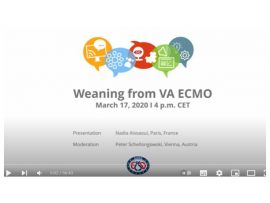
EuroELSO Webinar Topic: Weaning from VA ECMO Presentation: Nadia Aissaoui, Hershey Medical Center, USA / Paris, France Moderation: Peter Schellongowski, Vienna, Austria
Read More
Abstract Veno-venous extracorporeal membrane oxygenation (VV ECMO) has been used as a life-supporting modality for patients with severe respiratory failure because of coronavirus disease 2019 (COVID-19). We aim to evaluate..
Read More
Abstract Purpose. Obesity has been associated with an increased risk of respiratory complications and other systemic illnesses. Respiratory dynamics in an obese patient, combined with modified lung physiology of ARDS,..
Read More
Abstract Extracorporeal carbon dioxide removal (ECCO2R) has gained widespread use as a supposedly less invasive alternative for hypercapnic respiratory failure besides venovenous extracorporeal membrane oxygenation (VV ECMO). Despite technological advances,..
Read More