


Abstract OBJECTIVES: Neonates with respiratory failure are ideally supported with veno-venous rather than veno-arterial extracorporeal membrane oxygenation due to the reduced rate of neurologic complications. However, the proportion of neonates..
Read More
Abstract Objective: Zone 0 thoracic endovascular aortic repair (TEVAR) is associated with a high incidence of cerebral infarction mostly due to the embolic shower of a plaque from the aortic arch..
Read More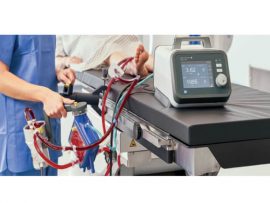
Abstract Extra-corporeal membrane oxygenation (ECMO) is growing in adoption and popularity, as demonstrated by the international registry maintained by the Extracorporeal Life Support Organization (ELSO). While initially an adaptation of..
Read More
Abstract Heparin has served as a mainstream for over eight decades. Clinically heparin-derived compounds significantly contribute to prevention and treatment of thrombotic events complicated in numerous medical conditions such as , and processes. Moreover..
Read More
Abstract Background RotaFlow and Levitronix CentriMag veno-arterial extracorporeal membrane oxygenation (ECMO) support systems have been investigated as treatment for refractory cardiogenic shock (CS). Methods Between 2004 and 2012, 119 consecutive..
Read More
Abstract Purpose of the Review The present review addresses clinicians and gives an overview about the experimental rationale for pharmacological conditioning associated with volatile anesthetics, opioids, and propofol; the current..
Read More
Abstract Background Pulsatile flow protects vital organ function and improves microcirculatory perfusion during extracorporeal membrane oxygenation (ECMO). Studies revealed that pulsatile shear stress plays a vital role in microcirculatory function..
Read More
Abstract Problem: Formative feedback, which is given in an ongoing fashion during the learning process, is fundamental to clinical education. However, dissatisfaction with formative feedback among residents is common. Difficulties..
Read More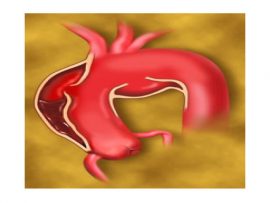
Abstract Background Acute Stanford type A aortic dissection (TAAD) is a life-threatening condition. Surgery is usually performed as a salvage procedure and is associated with significant postoperative early mortality and..
Read More
Abstract Purpose To confirm and illustrate the great variability of morphology of the Cerebral Arterial Circle (CAC)—also commonly called “Circle of Willis”—in current clinical Computed Tomography Angiography (CTA) practice. Methods..
Read More
Abstract The pericardium is a double-layered fibro-serous sac that envelops the majority of the surface of the heart as well as the great vessels. Pericardial fluid is also contained within..
Read More
Abstract Extracorporeal membrane oxygenation (ECMO) is often used in the management of COVID-19-related severe respiratory failure. We report the first case of a patient with COVID-19-related ARDS on ECMO support..
Read More
Abstract Background One of the challenges during cardiac surgery is to keep patients fully anticoagulated during the time and reversing at the end of surgery. For that purpose, heparin and its approved..
Read More
Off pump beating Zeraatian's technique of RA mass evacuation with just SVC and IVC choking. [playlist ids="18068"] Dr.Sam Zeraatian Nejad Davani, CEO of rockingham medical research ADKWA center as..
Read More
Patient with Chronic Thromboembolic Pulmonary HTN undergone pulmonary endarterectomy all steps from A to Z. [gallery ids="18057,18054,18051,18048"] [playlist ids="18060"] Dr.Sam Zeraatian Nejad Davani, CEO of rockingham medical research ADKWA center..
Read More
Descending thoracic aorta invasion by bone tumor. Dr.Sam Zeraatian Nejad Davani, CEO of rockingham medical research ADKWA center as well as Head of IUMS transplant and cardiovascular surgery department. ..
Read More
Patient with innominate artery and thoracic out let invasion of tumor undergone complete resection and tracheal reconstruction. In this patient you can also see fistula between esophagus as well as..
Read More
Complete extra cardiac Fontan Operation in patient with previous superior cavopulmonary anastomoses. [playlist ids="18041"] Dr.Sam Zeraatian Nejad Davani, CEO of rockingham medical research ADKWA center as well as Head..
Read More
Patient with coronary sinus abcess formation and bloct indergone bicaval total inflow cannulation abcess aggressive debridment and drainage and RA and Coronary Sinus as will valve annulus reconstruction with autologous..
Read More
Abstract Objective: Risk assessment tools typically used in congenital heart surgery (CHS) assume that various possible risk factors interact in a linear and additive fashion, an assumption that may not..
Read More
Abstract OBJECTIVES Recent data suggested that off-pump coronary artery bypass (OPCAB) may carry a higher risk for mortality in the long term when compared to on-pump coronary artery..
Read More
Abstract OBJECTIVES We investigated the anatomical evolution of residual aortic dissection after type A repair and factors associated with poor prognosis at a high-volume aortic centre. METHODS Between..
Read More
Patient with huge LT pulmonary artery epicardial trunc Space occupying tumor undergone complete resection off pump pathology was compatible with epicardial cyst which is very very rare phenomenon. [gallery ids="18019,18016,18013,18010"]..
Read More
Spontaneous RT coronary artery free rupture and hematoma within epicardium as well ad pericardial effusion undergone primary emergency repair with pericardial patch. [gallery ids="18006"] Dr.Sam Zeraatian Nejad Davani, CEO..
Read More
Abstract Arrhythmia-induced cardiomyopathy secondary to frequent ventricular premature contractions is a well-studied phenomenon; however, there is a paucity of data showing a similar association with frequent atrial premature contractions (APCs)...
Read More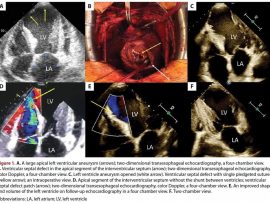
Referring to the discussion on effective methods of treatment for patients with a post-infarction left ventricular aneurysm and a ventricular septal defect (VSD) [1], we present the case of a..
Read More
Learning points: Hydatidosis or cystic echinococcosis is caused by infection with the metacestode stage of the tapeworm Echinococcus (family Taeniidae). The adult tapeworm is usually found in dogs or other..
Read More
Aula sobre ECMO. Prof. Elio Carvalho é Biomédico, Microbiologista e Perfusionista pela Unicamp, CLAP e SBCEC. É perfusionista do Hospital de Clínicas da Unicamp e Coordenador do Curso da Unicamp..
Read More
Abstract Neonates and children who have survived critical illness severe enough to require extracorporeal membrane oxygenation (ECMO) are at risk for neurologic insults, neurodevelopmental delays, worsening of underlying medical conditions,..
Read More
Abstract Background Little is known regarding whether hyperoxic reoxygenation was associated with higher risk of cardiovascular disorder following tetralogy of Fallot repair. Methods We performed a nested case–control study among..
Read More