


Join us for an exceptional educational and networking experience for the perfusion community and their families. July 17-19, 2026 Marriott Myrtle Beach Resort & Spa at Grande Dunes Myrtle Beach,..
Read More
1) Les Journées de Formation Perfusion (JFP) sont créées pour les perfusionnistes français ainsi que les perfusionnistes francophones qui travaillent hors de nos frontières. L’inscription aux JFP est conditionnée à l’adhésion..
Read More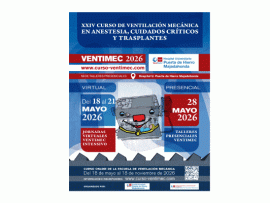
Estimados compañer@s y amig@s, Quiero presentaros la XXIV edición de nuestro Curso de Ventilación Mecánica en Anestesia, Cuidados Intensivos y Trasplantes, VENTIMEC 2026, que se celebrará los próximos 18-21 y 28 de..
Read More
Programma del corso Moderatori:Marta Velia Antonini Sandro Nalon Andrea Battisti 16:30-17:10Introduzione alla donazione da DCD: - categorie di donatori, aspetti etici, legali e procedurali Marta Velia Antonini - circuito: chiuso,..
Read More
Join Dr. Alexander Kersten (University Hospital Aachen, Germany), Dr. Marco Giani (University Hospital Milano-Bicocca, Italy), Prof. Matthieu Schmidt (University Hospital Pitié-Salpêtrière, France) and Dr. Stefan Gurney (University Hospitals Bristol and..
Read More
For the very first time in Bomet County, AGC Tenwek Cardiothoracic Centre, in collaboration with the Kenya Association of Thoracic Surgeons, will proudly host a landmark Cardiothoracic surgery & Cardiovascular..
Read More
Abstract Background Patients with severe respiratory failure frequently suffer from concomitant haemodynamic compromise. By correcting respiratory acidosis and permitting reduced mechanical ventilation pressures, venovenous extracorporeal membrane oxygenation (V-V ECMO) may..
Read More
Abstract Peri-device leak and device-related thrombus remain key challenges of current left atrial appendage occlusion (LAAO) owing to the incompatibility between the solid occluder and the left atrial appendage (LAA). Here..
Read More
Abstract Acute respiratory distress syndrome (ARDS) is a major cause of morbidity and mortality despite decades of progress in ventilatory support. Mechanical ventilation, while essential for oxygenation, may exacerbate lung..
Read More
Abstract Introduction: The absence of a congenital heart surgery national registry limits understanding of access, surgical volume, and mortality. This study analyzes the Brazilian administrative data to assess procedural distribution, outcomes,..
Read More
Abstract Background Socioeconomic inequalities have been associated with adverse outcomes in critically ill COVID-19 patients. Whether these disparities extend to the most severe ARDS patients treated with ECMO, regardless of..
Read More
Abstract Objectives Data on the role of obesity in patients undergoing minimally invasive cardiac surgery are sparse, and the longitudinal observations after minimally invasive mitral valve repair (MI-MVr) in obese..
Read More
Abstract Introduction Regional citrate anticoagulation (RCA) is the recommended first-line strategy for continuous renal replacement therapy (CRRT) circuits. Acute kidney injury is common in patients undergoing venoarterial extracorporeal membrane oxygenation..
Read More
Abstract Background Intravenous amino acids (AA) reduce acute kidney injury (AKI) in adult patients undergoing cardiac surgery. Because the optimal duration of AA infusion is unknown, we investigated the effect..
Read More
Abstract Background: Musculoskeletal disorders (MSDs) are highly prevalent among healthcare workers, particularly nurses, with reported prevalence rates ranging from 57% to 93%. Perfusionists are highly specialized healthcare professionals responsible for operating..
Read More
Abstract Objective This study assessed the impact of intraoperative goal-directed fluid therapy integrated within an Enhanced Recovery After Surgery program on early coagulation parameters, transfusion requirements, hemoglobin levels, chest tube..
Read More
Abstract Delaying the measurement of a complete blood count (CBC) for 6 to 24 hours after red blood cell transfusion remains a common practice in hospitals worldwide, despite the absence..
Read More
Abstract Hereditary spherocytosis (HS) is a rare inherited haemolytic anaemia. This case report outlines a neonatal patient with presumed HS requiring cardiopulmonary bypass (CPB) and the whole blood exchange transfusion..
Read More
Abstract Endothelin-1 is a potent regulator of vasomotor tone and promotes endothelium-dependent vasoconstriction of vascular smooth muscle. Dysregulated vasomotor tone is a hallmark of microvascular pathology following cardiac surgery involving..
Read More
Abstract BACKGROUND: The aim of this study was to present our institutional experience with periprocedural management of emergency cesarean section (CS) operations and maternal and fetal cardiac complications in pregnant..
Read More
Abstract Background and objective Cardiopulmonary bypass (CPB), though indispensable in cardiac surgery, carries significant risks of systemic embolization and organ injury. While cerebral and cardiac complications have been thoroughly investigated,..
Read More
Abstract Introduction Post-CPB bleeding remains a critical challenge in neonatal cardiac surgery, and early detection of coagulopathy to guide transfusion decisions may offer significant benefits. We hypothesized that routine use..
Read More
Abstract Introduction Monitoring indexed oxygen delivery (DO2i) is recommended during cardiopulmonary bypass (CPB) and a predictor of acute kidney injury (AKI). The use of lean body mass-adjusted blood flow rates..
Read More
Abstract Excessive right heart load imposes an acute or chronic injury on the right ventricle (RV), predisposing critically ill neonates and cardiac surgical patients to RV failure, low cardiac output..
Read More
Abstract Background: Postoperative delirium is a common and serious complication in surgical patients, often leading to prolonged hospitalisation and increased morbidity. Intranasal insulin has shown promising results in preventing postoperative..
Read More
Abstract Introduction Temporary mechanical circulatory support (tMCS) has become essential in managing severe cardiac dysfunction, particularly refractory cardiogenic shock (CS). Despite widespread adoption, the optimal use of tMCS is often..
Read More
Abstract Neuron-specific enolase (NSE) is a marker used to assess neurological impairment. Notwithstanding, the release of NSE into the circulation can also originate from erythrocytes and thrombocytes, signifying that even..
Read More
Abstract Background The predominant method for preventing cerebral infarction secondary to air embolism in cardiac surgery is the use of root vents to remove air. However, in the case of..
Read More
Abstract Objectives: To test the feasibility and safety of a randomized controlled trial (RCT) delivering nitric oxide into the sweep gas of extracorporeal membrane oxygenation (ECMO) circuits (sNO) in critically..
Read More
Abstract Background Postoperative complications in patients with acute type A aortic dissection (ATAAD) significantly affect their prognosis. This study investigates the association between cardiopulmonary bypass(CPB) weaning time and postoperative adverse..
Read More