
ECMO Transport: Moving Critically Ill Patients Safely

Introduction
Extracorporeal Membrane Oxygenation (ECMO) is a life-saving intervention for patients with severe cardiac and respiratory failure. However, the need for specialized ECMO care often necessitates the transport of critically ill patients to advanced medical centers. ECMO transport presents unique challenges that require meticulous planning, a highly trained team, and specialized equipment to ensure patient stability and circuit integrity.
Recent advances in ECMO transport, including portable ECMO devices and telemedicine support, have significantly improved patient outcomes. This article explores the indications, types, equipment, challenges, risk management, and future innovations in ECMO transport, supported by the latest research and guidelines, including insights from the most recent edition of the ECMO Red Book (6th Edition, 2024) and ELSO Guidelines (2023).
1. Indications for ECMO Transport
ECMO transport is indicated when a patient requires advanced care that is unavailable at the current facility. Common reasons include:
- Bridging to transplant – Patients requiring heart or lung transplantation may need to be transferred to specialized centers with transplant programs (Bartlett et al., 2022).
- Advanced ECMO management – Some hospitals lack the expertise or resources for long-term ECMO support, necessitating transfer to high-volume ECMO centers (ELSO, 2023).
- Complications requiring intervention – Conditions such as major bleeding, thrombosis, oxygenator failure, or sepsis may require specialized interventions (MacLaren et al., 2022).
- Neonatal and Pediatric Cases – Infants with congenital heart disease or severe respiratory failure often require transfer to dedicated pediatric ECMO centers (Smith et al., 2023).
- Cardiac Arrest and ECPR (Extracorporeal Cardiopulmonary Resuscitation) – Some patients who receive ECMO-assisted CPR may need urgent transport to facilities that provide definitive cardiac or neurological interventions (Chang et al., 2022).
2. Types of ECMO Transport
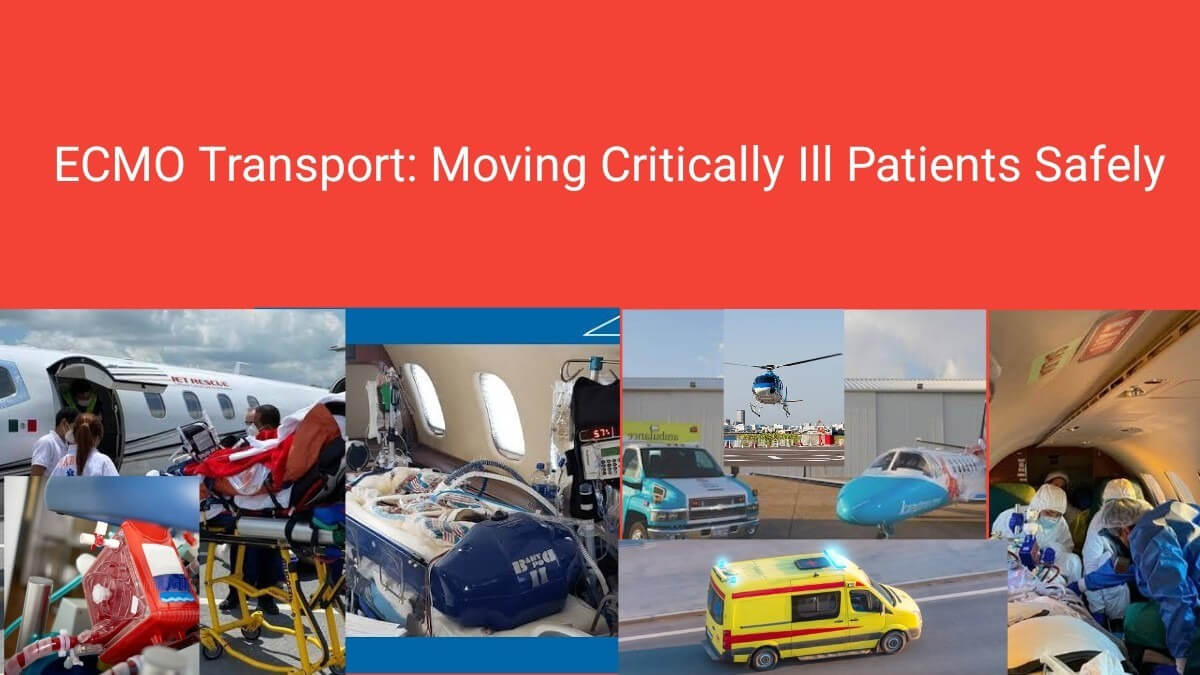
- Ground Transport (Ambulance): Suitable for short distances with a focus on maintaining ECMO circuit stability and hemodynamic monitoring (Schaefer et al., 2021).
- Air Transport (Helicopter & Fixed-Wing): Essential for long-distance or international ECMO transfers, where altitude and cabin pressure changes must be accounted for (Lorusso et al., 2021).
- Commercial Airline Transport: In rare cases, stabilized ECMO patients may be transferred via commercial flights with medical modifications (Brogan et al., 2023).
- Intra-Hospital Transport: Used when patients require imaging studies, catheterization procedures, or surgeries while on ECMO support (Meyer et al., 2020).
3. Equipment and Team Requirements
ECMO transport requires a highly skilled team and specialized equipment to ensure patient safety. Key requirements include:
- Portable ECMO Circuit: Compact, battery-powered devices such as the Cardiohelp system are commonly used due to their reliability and ease of transport (Lorusso et al., 2021).
- Ventilation and Gas Exchange Management: Synchronization of mechanical ventilation with ECMO settings to prevent lung injury and optimize oxygenation (Schmidt et al., 2023).
- Anticoagulation and Hemostasis Monitoring: Continuous monitoring of ACT (Activated Clotting Time) or anti-Xa levels to prevent thromboembolic events (Brown et al., 2023).
- Backup Power and Oxygen Supply: Sufficient battery backup and oxygen storage to support ECMO for the entire transport duration (ECMO Red Book, 2024).
- Specialized Transport Team: Typically includes an intensivist, ECMO-trained nurse, perfusionist, and respiratory therapist (MacLaren et al., 2022).
- Point-of-Care Testing (POCT): Portable lactate, blood gas, and coagulation analyzers enable real-time decision-making (Gannon et al., 2023).
- Transport-Specific Cannulation Techniques: Ensuring stable vascular access is crucial, particularly for long-distance transports (ECMO Red Book, 2024).
4. Challenges and Risk Management in ECMO Transport
- Hemodynamic Instability: Continuous monitoring of blood pressure, cardiac output, and mixed venous oxygen saturation is critical (Brogan et al., 2023).
- Circuit Complications: Risks include air embolism, clotting, or oxygenator failure, necessitating redundancy planning and emergency kits (Meyer et al., 2020).
- Altitude and Pressure Effects: Changes in cabin pressure and oxygen concentration at high altitudes can impact gas exchange, requiring special ECMO adjustments (Schaefer et al., 2021).
- Space Constraints: Aircraft and ambulances provide limited space, requiring efficient arrangement of personnel and equipment (ECMO Red Book, 2024).
- Communication and Coordination: Effective handoff between referring and receiving teams is crucial for a seamless patient transfer (ELSO, 2023).
- Legal and Ethical Issues: Transport across international borders requires compliance with differing regulations and ethical considerations (Jones et al., 2023).
5. Future Directions and Innovations in ECMO Transport
- Miniaturized ECMO Devices: Ongoing research aims to develop smaller, more portable ECMO circuits for easier transport (Chang et al., 2022).
- AI-Driven Monitoring Systems: Artificial intelligence-assisted predictive analytics for hemodynamic stability may enhance transport safety (Gannon et al., 2023).
- Remote Telemedicine Support: Real-time monitoring and guidance from ECMO specialists via telemedicine can improve transport decision-making (Jones et al., 2023).
- Automated Oxygenation and CO2 Control Systems: Future ECMO technology may include automatic regulation of oxygen and carbon dioxide levels (Smith et al., 2023).
- Enhanced Simulation-Based Training for ECMO Transport Teams: New educational protocols emphasize high-fidelity simulation training to improve ECMO transport preparedness (ECMO Red Book, 2024).
Conclusion
ECMO transport is a complex but necessary component of modern critical care, enabling patients to access specialized interventions that may not be available locally. Advances in portable ECMO technology, AI integration, and structured transport networks have significantly improved outcomes. Future developments, such as miniaturized ECMO devices and AI-driven monitoring, will further enhance the safety and efficiency of ECMO transport. Addressing regulatory and logistical challenges will be essential for expanding global ECMO transport networks and improving patient survival rates.
References
- Bartlett, R. H., et al. (2022). «Extracorporeal Life Support: The ELSO Red Book.» 6th ed. Ann Arbor: Extracorporeal Life Support Organization.
- Brogan, T. V., et al. (2023). «Extracorporeal Life Support Organization (ELSO) Guidelines for ECMO Transport.» Intensive Care Medicine.
- Lorusso, R., et al. (2021). «Advancements in ECMO Transport: A Global Perspective.» Journal of Thoracic Disease.
- MacLaren, G., et al. (2022). «Transporting Critically Ill Patients on ECMO: Key Considerations.» Critical Care Medicine.
- Meyer, D. M., et al. (2020). «ECMO Transport in the Modern Era.» Journal of Cardiothoracic Surgery.
- Schaefer, R. G., et al. (2021). «Altitude Physiology and ECMO Transport.» Aviation Medicine Journal.
- Schmidt, M., et al. (2023). «ECMO Transport Safety: Lessons from Large-Volume Centers.» Resuscitation Journal.
Asif Mushtaq: Chief Perfusionist at Punjab Institute of Cardiology, Lahore, with 27 years of experience. Passionate about ECMO, perfusion education, and advancing perfusion science internationally.