


The ELSO Interim Guidelines for venoarterial extracorporeal membrane oxygenation (VA ECMO) is timely. I would like to raise a few points on weaning recommendations. First, the parameters detailed in Figure 11..
Read More
Abstract Over the past decade, the use of extracorporeal membrane oxygenation (ECMO) has increased exponentially, from approximately 30–40 patients per year in the United States 20 years ago, to over..
Read More
Abstract We describe the successful transplantation of a brain-dead donor supported by veno-arterial extracorporeal membrane oxygenation (VA-ECMO) after cardiac arrest secondary to pulmonary embolism. The donor was a 50-year-old female..
Read More

Abstract Venoarterial extracorporeal membrane oxygenation (VA-ECMO) is a bridging therapy for refractory cardiogenic shock, and limb ischemia is a concern with femoral cannulation. Because of the rich collateral pelvic circulatory..
Read More
Abstract Postinfarct ventricular septal defect (PIVSD) is associated with high mortality and the management of these patients has been a challenge with little improvement in outcomes. We commenced a protocol..
Read More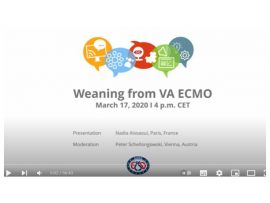
EuroELSO Webinar Topic: Weaning from VA ECMO Presentation: Nadia Aissaoui, Hershey Medical Center, USA / Paris, France Moderation: Peter Schellongowski, Vienna, Austria
Read More
Abstract Objectives Cardiac injury has been reported in up to 20%-to-30% of patients with COVID-19, and severe disease can lead to cardiopulmonary failure. The role of mechanical circulatory support in..
Read More
Abstract Introduction Peripheral veno-arterial extracorporeal membrane oxygenation (VA ECMO) creates a retrograde flow along the aorta competing with the left ventricle (LV) in the so-called ‘mixing zone’ (MZ). Detecting it..
Read More
Abstract Background Venoarterial extracorporeal membrane oxygenation (ECMO) provides mechanical support for critically ill patients with cardiogenic shock. Typically, the size of the arterial return cannula is chosen to maximize flow...
Read More
Abstract Peripheral venoarterial extracorporeal membrane oxygenation (VA ECMO) for acute cardiac failure reestablishes normal oxygen delivery and perfusion. However, VA ECMO can be limited by insufficient ventricular unloading, resulting in..
Read More
Abstract Importance The optimal approach to the use of venoarterial extracorporeal membrane oxygenation (ECMO) during cardiogenic shock is uncertain. Objective To determine whether early use of moderate hypothermia (33-34 °C) compared with..
Read More
Abstract Background cardiopulmonary resuscitation (ECPR) has gained increasing as a promising but resource-intensive intervention for out-of-hospital cardiac arrest (OHCA). There is little data to quantify the impact of this intervention..
Read More
Abstract The role of intraoperative mechanical support during lung transplantation (LTx) is essential to provide a safe hemodynamic and ventilatory status during critical intraoperative events. This hemodynamic and ventilatory stability..
Read More
Abstract Introduction Peripheral veno-arterial extracorporeal membrane oxygenation (VA ECMO) creates a retrograde flow along the aorta competing with the left ventricle (LV) in the so-called ‘mixing zone’ (MZ). Detecting it..
Read More
Abstract Prognostic significance of elevated serum lactate in patients on venoarterial extracorporeal membrane oxygenation (ECMO) is widely known. Our objective was to study the utility of lactate measured at different points of..
Read More
Abstract Purpose Percutaneous cannulation is increasingly used for veno-arterial extracorporeal membrane oxygenation (VA-ECMO). However, there is limited evidence about the benefit of this approach compared with conventional surgical cannulation. By..
Read More
Abstract Veno-arterial extracorporeal membrane oxygenation (VA-ECMO) is used as mechanical circulatory support in cardiogenic shock (CS). It restores peripheral perfusion, at the expense of increased left ventricle (LV) afterload. In..
Read More
Abstract Background During peripheral extracorporeal veno-arterial membrane oxygenation (VA-ECMO) support, subclavian arterial cannulation provides, in comparison to femoral arterial cannulation, an anterograde flow which may prevent from left ventricular (LV)..
Read More
Abstract Background:Patients with cardiogenic shock due to acute myocardial infarction (AMI) can rapidly undergo veno-arterial extracorporeal membrane oxygenation (VA-ECMO) therapy to recover cardiac output and decrease mortality. However, the clinical..
Read More
Abstract Objectives The aim of this study was to quantify and understand the unloading effect of percutaneous balloon atrial septostomy (BAS) in acute (CS) treated with venoarterial (VA) membranous oxygenation (ECMO). Background..
Read More
Abstract Venoarterial extracorporeal membrane oxygenation may be used for circulatory support in cardiogenic shock as a bridge to recovery, a bridge to a ventricular assist device (VAD), or a bridge..
Read More
Abstract Background management during venoarterial (ECMO) is particularly difficult in postcardiotomy shock patients given a significant bleeding risk. We sought to determine the effect of treatment on bleeding and thrombosis risk for..
Read More
Abstract Background: Peripheral veno-arterial extracorporeal membrane oxygenation (V-A ECMO) is used to support circulatory failure refractory to conventional therapy. However, data on the heart-ECMO interaction at different levels of ECMO..
Read More
Abstract Acute brain injury (ABI) increases morbidity and mortality in patients with veno-arterial extracorporeal membrane oxygenation (VA-ECMO). Optimal neurologic monitoring methods have not been well-explicated. We studied the use of..
Read More
Abstract Introduction and objectives Lactate and its evolution are associated with the prognosis of patients in shock, although there is little evidence in those assisted with an extracorporeal venoarterial oxygenation..
Read More
Abstract Background Age over 70 years seems to confer poor prognosis for patients under mechanical circulatory support (MCS). Advanced age is usually a relative contraindication. Our objective was to assess the..
Read More
Abstract Stroke has potentially devastating consequences for patients receiving veno-arterial extracorporeal membrane support (VA-ECMO). Arterial cannulation sites for VA-ECMO include the ascending aorta, axillary artery, and femoral artery. However, the..
Read More
Abstract Introduction: Elevated left atrial pressures (LAP) are associated with worse outcomes among patients with cardiogenic shock (CS), yet there are limited data on the utility of continuous invasive monitoring of..
Read More
Abstract The researchers realized that more than half a million people in America suffer cardiac arrest each year. In Europe, more that quarter a million people suffer out of hospital..
Read More