

Abstract An editorial published in April 2022 discusses the benefits and pitfalls of veno-arterial extracorporeal membrane oxygenation (VA-ECMO) combined with intra-aortic balloon pumps (IABP) to manage CS. The complete manuscript,..
Read More
Abstract The use of venoarterial extracorporeal membrane oxygenation (VA-ECMO) following acute myocardial infarction with cardiogenic shock (AMI-CS) is increasing, but the ability to predict favorable outcomes with support remains limited...
Read More
Abstract Although mechanical circulatory support (MCS) has been used to support patients with cardiogenic shock (CS) for many years, recent advances in device technology, together with the lackluster performance of..
Read More
Abstract Introduction In peripheral percutaneous (VA) extracorporeal membrane oxygenation (ECMO) procedures the femoral arteries perfusion route has inherent disadvantages regarding poor upper body perfusion due to watershed. With the advent..
Read More
Abstract Background As utilization of veno-arterial (VA-ECLS) in treatment of (CS) continues to expand, clinical variables that guide clinicians in early recognition of myocardial recovery and therefore, improved survival, after VA-ECLS are..
Read More
Abstract Veno-arterial extra-corporeal membrane oxygenation (VA ECMO) in children is often established by cannulation of the right carotid artery and the right internal jugular vein. Cerebral infarction which is sometimes..
Read More
Abstract Background This study aims to compare lactate and central venous blood gas in the prediction of outcome in pediatric venoarterial mode extracorporeal membrane oxygenation (V-A ECMO). Method This was..
Read More
Abstract Background and Aim of the Study Acute cardiovascular failure remains a leading cause of death in severe poisonings. Veno-arterial extracorporeal membrane oxygenation (VA-ECMO) has been increasingly used as a..
Read More
Abstract This study evaluated differences in efficacy and safety outcomes with bivalirudin compared with unfractionated heparin (UFH) in patients with cardiogenic shock requiring venoarterial extracorporeal membrane oxygenation (VA ECMO). We..
Read More
Abstract Background: Differential hypoxemia (DH) has been recognized as a clinical problem during veno-arterial extracorporeal membrane oxygenation (VA ECMO) although its features and consequences have not been fully elucidated. Purpose:..
Read More
Abstract Aims Intracranial haemorrhage (ICH) is one of the most serious complications of adult patients treated with venoarterial extracorporeal membrane oxygenation (VA-ECMO) and is associated with increased morbidity and mortality...
Read More
Abstract Pediatric cardiac extracorporeal membrane oxygenation (ECMO) patients have high mortality rates. The purpose of our study was to develop and validate the Pediatric Survival After Veno-arterial ECMO (Pedi-SAVE) score for predicting..
Read More
Abstract Background The optimal strategy of weaning veno-arterial (V-A) extracorporeal membrane oxygenation (ECMO) remains poorly described. Pump-controlled retrograde trial off (PCRTO) involves serial decremental pump revolutions until a retrograde flow..
Read More
Abstract Background Patients with cardiogenic shock or cardiac arrest undergoing venoarterial extracorporeal membrane oxygenation (V-A ECMO) frequently present with blood glucose levels out of normal range. The clinical relevance of..
Read More
Abstract Aims Venoarterial extracorporeal membrane oxygenation (VA-ECMO) is increasingly being used to support patients in cardiogenic shock (CS). Early determination of disposition is paramount, as longer durations of support have..
Read More
Abstract Background: Initiation of veno-arterial (VA) Extracorporeal Membrane Oxygenator (ECMO) is associated with severe complications. It is unknown whether these adverse consequences occur more often after initiations during out of..
Read More
Abstract Objectives To compare the outcomes of patients with postcardiotomy shock treated with venoarterial (VA-ECMO) only compared with VA-ECMO and intra-aortic balloon pump (IABP). Design A retrospective multicenter registry study. Setting..
Read More
Abstract This is a summary of a case study entitled “Surgical pulmonary embolectomy on VA-ECMO” reported by Rachel Steinhorn, Adam A. Dalia, Edward A. Bittner, and Marvin G. Chang analyzing the..
Read More
Abstract Purpose A survival gap between weaning from venoarterial-extracorporeal membrane oxygenation (VA-ECMO) and the hospital discharge has been consistently reported. The aim of this study is to investigate the clinical..
Read More
Abstract Importance The optimal approach to the use of venoarterial extracorporeal membrane oxygenation (ECMO) during cardiogenic shock is uncertain. Objective To determine whether early use of moderate hypothermia (33-34 °C) compared with..
Read More
Abstract Introduction Propofol infusion syndrome (PRIS) is a rare entity that could lead to profound cardiogenic shock (CS). Mitochondrial toxicity and sympathetic blockade are the mechanisms leading to CS in..
Read More
The ELSO Interim Guidelines for venoarterial extracorporeal membrane oxygenation (VA ECMO) is timely. I would like to raise a few points on weaning recommendations. First, the parameters detailed in Figure 11..
Read More
Abstract Over the past decade, the use of extracorporeal membrane oxygenation (ECMO) has increased exponentially, from approximately 30–40 patients per year in the United States 20 years ago, to over..
Read More
Abstract We describe the successful transplantation of a brain-dead donor supported by veno-arterial extracorporeal membrane oxygenation (VA-ECMO) after cardiac arrest secondary to pulmonary embolism. The donor was a 50-year-old female..
Read More
Abstract Venoarterial extracorporeal membrane oxygenation (VA-ECMO) is a bridging therapy for refractory cardiogenic shock, and limb ischemia is a concern with femoral cannulation. Because of the rich collateral pelvic circulatory..
Read More
Abstract Postinfarct ventricular septal defect (PIVSD) is associated with high mortality and the management of these patients has been a challenge with little improvement in outcomes. We commenced a protocol..
Read More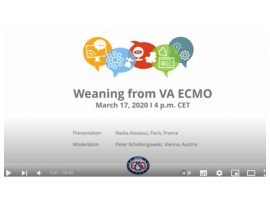
EuroELSO Webinar Topic: Weaning from VA ECMO Presentation: Nadia Aissaoui, Hershey Medical Center, USA / Paris, France Moderation: Peter Schellongowski, Vienna, Austria
Read More
Abstract Objectives Cardiac injury has been reported in up to 20%-to-30% of patients with COVID-19, and severe disease can lead to cardiopulmonary failure. The role of mechanical circulatory support in..
Read More
Abstract Introduction Peripheral veno-arterial extracorporeal membrane oxygenation (VA ECMO) creates a retrograde flow along the aorta competing with the left ventricle (LV) in the so-called ‘mixing zone’ (MZ). Detecting it..
Read More