


Abstract Introduction Off-pump coronary artery bypass grafting (OPCABG) was introduced many years ago aiming to reduce the known complications of conventional on-pump coronary surgeries. Heparin is required during the procedures,..
Read More
Abstract The common conception of “heparin rebound” invokes heparin returning to circulation in the after apparently adequate intraoperative reversal with . This is believed to portend increased and provides the rationale for administering..
Read More
Abstract Objectives In our center, an unusual rate of patients had abnormalities of hemostasis in immediate postoperative period of cardiac surgery. Our objectives were to identify the cause of these..
Read More
Abstract Heparin anticoagulation increases the bleeding risk during extracorporeal life support (ECLS). This study determined whether factor XII (FXII) silencing using short interfering RNA (siRNA) can provide ECLS circuit anticoagulation without bleeding. Adult..
Read More
Abstract Introduction There are no randomized controlled trials comparing low and high activated partial thromboplastin time (aPTT) targets in heparinized adult veno-arterial (VA) extracorporeal membrane oxygenation (ECMO) patients. Our systematic..
Read More
Abstract Extracorporeal membrane oxygenation (ECMO) poses unique thrombotic and hemorrhagic risks, and the optimal anticoagulant choice is unknown. We systematically searched Ovid EBM Reviews, Ovid Embase, Ovid Medline, Scopus, and..
Read More
Abstract The use of heparin for anticoagulation has changed the face of cardiac surgery by allowing a bloodless and motionless surgical field throughout the introduction of cardiopulmonary bypass (CPB). However,..
Read More
Abstract The effect and safety of bivalirudin compared with heparin in patients undergoing extracorporeal membrane oxygenation (ECMO) remains unclear. Therefore, we conducted a systematic review and meta-analysis to compare the effectiveness and..
Read More
Abstract Introduction Our study aim was to explore how different protamine-heparin ratios impacted enzymatic coagulation and acellular fibrin clot growth in plasma using an in vitro model. We hypothesized that..
Read More
Abstract Objectives Despite the increasing utilization of mechanical circulatory support (MCS) devices, the 4Ts and heparin-induced thrombocytopenia (HIT) Expert Probability (HEP) scores have not been validated in patients with suspected..
Read More
Abstract In this study, we have evaluated and examined various nursing effects of improved administration of protamine sulfate neutralizing heparin after cardiopulmonary bypass. For this purpose, retrospective analysis was made..
Read More
Abstract Background Thrombocytopenia (platelet count below 150 x 103/μL) is a common finding after open-heart surgery and can lead to various complications, including patient death. This study aimed to determine..
Read More
Abstract Systemic is necessary before (CPB) in cardiac surgery, and administration to neutralize heparin for is required at the end of CPB. Because protamine is an allogeneic protein extracted from the sperm of specific..
Read More
Abstract The use of extracorporeal membrane oxygenation (ECMO) for acute cardiac and/or respiratory failure has grown exponentially in the past several decades. Systemic anticoagulation is a fundamental element of caring..
Read More
Abstract Known limitations of unfractionated heparin (UFH) have encouraged the evaluation of anticoagulant aptamers as alternatives to UFH in highly procoagulant settings such as cardiopulmonary bypass (CPB). Despite progress, these..
Read More
Abstract Extracorporeal membrane oxygenation (ECMO) contributes to coagulopathy, necessitating systemic anticoagulation to prevent thrombosis. Traditionally, unfractionated heparin (UFH) has been the anticoagulant of choice, however, due to many inadequacies new evidence suggests..
Read More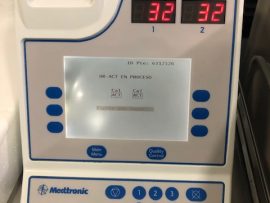
Abstract Introduction: The Activated Clotting Time (ACT) is commonly used to manage anticoagulation during cardiac surgery. The aim of this study was to compare the older manually operated Hemochron® Response and..
Read More
Abstract OBJECTIVES: A significant proportion of patients with coronavirus disease 2019 requiring venovenous extracorporeal membrane oxygenation at our institution demonstrated heparin resistance, which in combination with a heparin shortage resulted..
Read More
Abstract Heparin resistance is suspected when more heparin than usual is needed to achieve a therapeutic range of activated partial-thromboplastin time. Management may include increasing the heparin dose, supplementing antithrombin..
Read More
Abstract BACKGROUND: Heparin-induced thrombocytopenia (HIT) is an immune-mediated adverse reaction to heparin. Patients undergoing cardiac surgery with cardiopulmonary bypass (CPB) are routinely anticoagulated with heparin before the initiation of bypass...
Read More
Abstract Protamine is mainly used to reverse the anticoagulant effect of heparin after cardiopulmonary bypass (CPB). Unfortunately, it is associated with adverse clinical reactions ranging from minor cardiopulmonary instability to..
Read More
Abstract Background Heparin-induced thrombocytopenia (HIT) is an immune-mediated reaction to heparin that provokes a prothrombotic state and causes a decline in platelet count. Data describing outcomes of HIT after cardiac..
Read More
Abstract Heparin has served as a mainstream for over eight decades. Clinically heparin-derived compounds significantly contribute to prevention and treatment of thrombotic events complicated in numerous medical conditions such as , and processes. Moreover..
Read More
Abstract Extracorporeal membrane oxygenation (ECMO) is often used in the management of COVID-19-related severe respiratory failure. We report the first case of a patient with COVID-19-related ARDS on ECMO support..
Read More
Abstract BACKGROUND: The standardized management of anticoagulation during the cardiopulmonary bypass seems inaccurate because of patients and surgeries variability. This study evaluates if an individualized management of heparin and protamine..
Read More
Abstract Heparin is the earliest and most widely used anticoagulant and antithrombotic drug that is still used in a variety of clinical indications. Since it was discovered in 1916, after..
Read More
Abstract Background and Objectives Heparin-induced thrombocytopenia (HIT) is an antibody-mediated condition that leads to thrombocytopenia and possible thrombosis. Patients with HIT who require cardiac surgery pose a challenge as high..
Read More
Abstract Coagulation factor XII (fXII) is a plasma serine protease which belongs to the contact activation complex responsible for initiating the intrinsic coagulation pathway. fXII deficiency is a rare congenital..
Read More
Abstract Background Diagnosis of heparin-induced thrombocytopenia (HIT) requires pre-test probability assessment and dedicated laboratory assays. Objective To develop a pre-test score for HIT. Design Observational; analysis of prospectively collected data..
Read More
Abstract Extracorporeal membrane oxygenation (ECMO) bridge to lung transplantation (LuTX) exposes the patients to a high risk of perioperative bleeding secondary to systemic anticoagulation and coagulation factors deficiency. With this..
Read More