
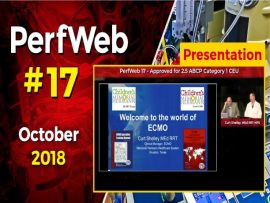

Mr. Curt Shelley, MEd, RRT-NPS discusses pediatric ECMO and is interviewed by Joe Basha, CCP about the program he is the director of at Memorial Hermann, Memorial Children's, Texas Medical..
Read More
The panel discusses the advantages and challenges that these devices pose in regards to accuracy and dependability, especially in artificial circulatory support and ECMO.
Read More
Dr. Hany Samir and a panel of experienced perfusionists describe and discuss ECMO cannulation strategies for ARDS, Cardiac Failure or full CardioPulmonary support. The panel provides case studies and explores..
Read More
Joe presents data on the commonality of clot burden in the ECMO circuit and how difficult it is to detect without a tool that can directly measure intra-oxygenator volume in..
Read More
Christine Perme, PT, CCS, FCCM discusses the physical therapy of long term ECMO patients. Christine and the panel give examples of and discuss ambulating our ECMO patients to maintain their..
Read More
ECMO (Extracorporeal Membrane Oxygenation) patient selection is a complex and often difficult decision for any healthcare provider that orders or decides on the appropriateness of ECMO therapy for their patients. ..
Read More
Excellent presentation and discussion of recirculation in you V-V ECMO circuit. Single or double cannulation techniques and learn how increased flows and volume changes can affect the amount of recirculation..
Read More
Dr. Hany Samir, Dr. Juan Carlos Zubieta, and perfusionists Rebecca Bolkavac and Joe Basha discuss ECMO as a bridge to transplant for patients suffering from pulmonary hypertension.
Read More
Dr. Hany Samir lectures and discusses the use of ECPR (Extracorporeal Cardio Pulmonary Resuscitation) for sudden cardiac arrest. Dr. Samir discusses special consideration and outcomes associated with ECPR (Extracorporeal Cardio Pulmonary..
Read More
Dr. Hany Samir lectures and discusses the use of ECPR (Extracorporeal Cardio Pulmonary Resuscitation) for sudden cardiac arrest. Dr. Hany Samir and Mat Warhoover, CCP from Vanderbilt discuss the survival..
Read More
An expert panel with decades of ECMO experience managing many ECMO patients discuss the factors that influence patient selection for ECMO support.
Read More
Joe Basha, CCP and John Ingram, CCP talk about anticoagulation strategies for ECMO patients. Joe and John discuss SCCM guidelines and their own experiences with different anticoagulation protocols.
Read More
John Ingram, CCP and Joe Basha, CCP discuss how to evaluate the effectiveness of your ECMO cannulation strategy and of your ECMO therapeutic goals and metrics.
Read More
Another excellent review by John Ingram, CCP of various ECMO cannulation strategies, including basic cannulation and exotic cannulation strategies.
Read More
Joe discusses his experiences with managing a perfusion practice, ecmo volume, and safety during the Coronavirus pandemic. Implication for perfusion My experience as a perfusion business owner.
Read More
Joe Basha, CCP and John Ingram, CCP talk about anticoagulation strategies for ECMO patients. Joe and John discuss SCCM guidelines and their own experiences with different anticoagulation protocols.
Read More
Joe presents data on the commonality of clot burden in the ECMO circuit and how difficult it is to detect without a tool that can directly measure intra-oxygenator volume in..
Read More
Tammy Sparacino Journal Club - John Ingram Knowledge Nuggets Tammy Sparacino Journal Club: Heparin - free ( VV ECMO) Veno - Venous Extracorporeal Membrane Oxygenation in a multiple trauma patient:..
Read More
The learner will be able to discuss anticoagulation strategies for patients on ECMO.
Read More
Dr. Keshen Mathura discusses the MicroVision microvascular scanner and discusses and demonstrates how this tool to visualize the microcirculation can be used in the cardiac and critical care units to..
Read More
Tammy Sparacino, CCP lectures on non or minimally invasive cardiac output devices. The panel discusses the advantages and challenges that these devices pose in regards to accuracy and dependability, especially..
Read More
Joe Basha, CCP presents data on the expanded use of ECMO around the world, including a novel approach towards use of ECMO outside of the hospital as rescue therapy for..
Read More
Review of cardioplegia and lecture on novel cardioplegia techniques with Del Nido. Lecture and discussion on ECMO survival and patient selection and timing of ECMO therapy initiation.
Read More
Lectures and panel discussion on Trans-Cranial Doppler, Novel approach for Minimally Invasive Mitral Valve Repair with Hypekalemia, and management of the ECMO patient.
Read More
Backup perfusion coverage for TAVR is a standard of care in the United States. The panel explores other centers in Europe that does not provide any backup coverage and discusses..
Read More
The learner will be able to describe techniques to provide perfusion standby for Trans-catheter Aortic Valve Replacement (TAVR) including ECMO.
Read More
How ECMO contributes to maintaining kidney dysfunction and casually participates in the development of AKI (Acute Kidney Injury).
Read More
The COVID-19 pandemic has raised challenging questions about the rationing of intensive care unit (ICU) beds, mechanical ventilators, and extracorporeal membrane oxygenation (ECMO). Experts have recommended that ECMO be..
Read More
Abstract OBJECTIVES: With evidence of benefits of pediatric palliative care (PPC) integration, we sought to characterize subspecialty PPC referral patterns and end of life (EOL) care in pediatric advanced heart..
Read More
Abstract Background: Heparin is the widely used anti-coagulation strategy for patients on extracorporeal membrane oxygenation (ECMO). Nevertheless, heparin-induced thrombocytopenia (HIT) and acquired anti-thrombin (AT) deficiency preclude the use of heparin..
Read More