
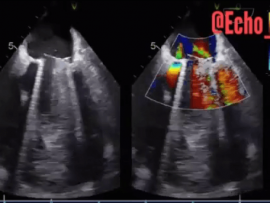

Paravalvular Leakage at 3 o’clock of Mitral Valve. Mohammed Zidan, MBBCH, M.Sc Cardiology (Cardiology, Echocardiography and interventional Cardilogy Specialist at Al-Azhar university), Cairo, Egypt.
Read More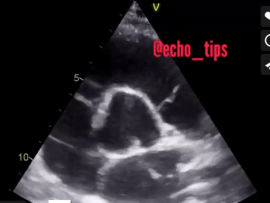
Mohammed Zidan, MBBCH, M.Sc Cardiology (Cardiology, Echocardiography and interventional Cardilogy Specialist at Al-Azhar university), Cairo, Egypt.
Read More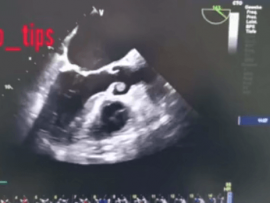
72 years ald female patient admitted to hospital because of delirium and hypertensive crises. In TTE we found clearly suspicious finding on the RCC of the Aortic Valve. For further..
Read More
Abstract The guideline provides a practical step-by-step guide in order to facilitate high-quality echocardiographic studies of patients with aortic stenosis. In addition, it addresses commonly encountered yet challenging clinical scenarios..
Read More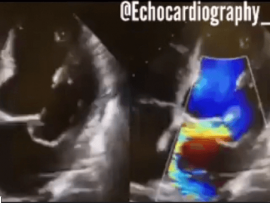
- Barlows prolapse. - Dilated left chambers, PMVL prolapse+ severe eccentric MR, Coanda effect, minimal pericardial effusion. - PML prolapse, severe MR eccentric jet, Dilated LA, Normal Lv systolic function.....
Read More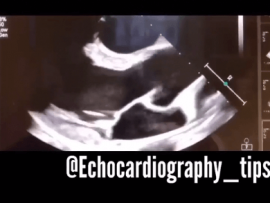
Mohammed Zidan, MBBCH, M.Sc Cardiology (Cardiology, Echocardiography and interventional Cardilogy Specialist at Al-Azhar university), Cairo, Egypt.
Read More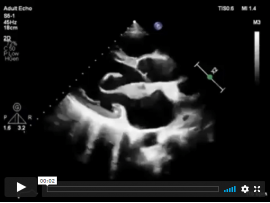
A 22-year-old man presented with palpitations and chest discomfort. Echocardiography revealed an enlarged, thickened mitral-valve leaflet with systolic prolapse of multiple segments (shown in a video), and a diagnosis of..
Read More
“Extracorporeal Oxygenation and Coronavirus Disease 2019 Epidemic: Is the Membrane Fail-Safe to Cross Contamination?” - Tammy Sparacino Journal Club. Surfactant - John Ingram Knowledge Nuggets. Venovenous extracorporeal membrane oxygenation (ECMO)..
Read More
Abstract We describe the successful transplantation of a brain-dead donor supported by veno-arterial extracorporeal membrane oxygenation (VA-ECMO) after cardiac arrest secondary to pulmonary embolism. The donor was a 50-year-old female..
Read More
Abstract Background To compare the safety and efficacy of low-dose anticoagulation (LA) with that of standardized dose anticoagulation (SA) for patients supported with extracorporeal membrane oxygenation (ECMO). Methods PubMed, MEDLINE,..
Read More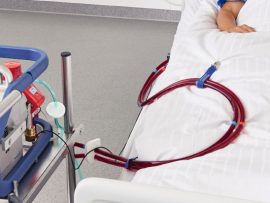
Abstract Extracorporeal life support (ECLS) for severe respiratory failure has seen an exponential growth in recent years. Extracorporeal membrane oxygenation (ECMO) and extracorporeal CO2 removal (ECCO2R) represent two modalities that can..
Read More
Abstract Although de‐airing procedures are commonly performed during cardiac surgery, use of these procedures is not necessarily based on evidence. Uncertainly remains around the size of bubbles that can be..
Read More
Abstract Introduction The role of intra-aortic balloon pumps (IABP) in high-risk patients undergoing (CABG) surgery remains controversial. We report the 5-year experience from a new Australian centre. Methods We retrospectively analysed..
Read More
Antecedent ACE-inhibition, inflammatory response, and cardiac surgery associated acute kidney injury
Abstract Cardiopulmonary bypass (CPB) may trigger organs damage, including kidney injury, due to a massive cytokine release. In this observational, prospective study, we analyzed the possible impact of chronic treatment..
Read More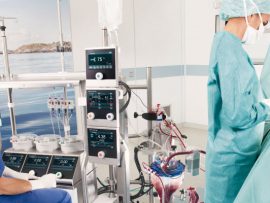
Abstract Background Acute Kidney Injury (AKI) adversely affects outcomes after cardiac surgery. A major mediator of AKI is the activation of leukocytes through exposure to the cardiopulmonary bypass circuit. We..
Read More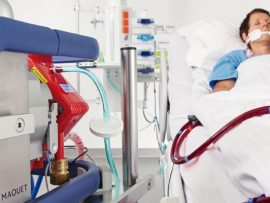
Abstract Despite advances in medical technology, the mortality rate for severe acute respiratory distress syndrome (ARDS) remains high at around 40% []. In recent years, multiple studies, systematic reviews, and..
Read More
Abstract Background: Acute type A aortic dissection (ATAAD) has a high risk of perioperative bleeding and often requires extensive blood product infusions. Analysis of the changes in coagulation and fibrinolysis..
Read More
Abstract Objectives: Cardiac postoperative cognitive dysfunction (c-POCD) is a common complication. This article established a nomogram by analyzing preoperative and intraoperative data to help identify high-risk patients and take effective..
Read More
Parasternal short axis view, Apical four chamber view “A4C”. By placing the probe in the 5th to 7th intercostal space with a pointer directed to the lateral side till u..
Read More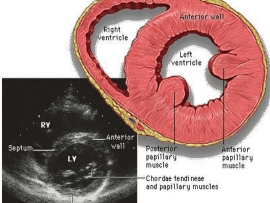
Parasternal short axis view. Papillary muscle level. The importance is ; 1) can assess the LV function 2)Ischemia “RWMAs” 3)VSD 4)Flattened D-shaped septum in Pulmonary embolism 5)LV wall thickness 6)Papillary..
Read More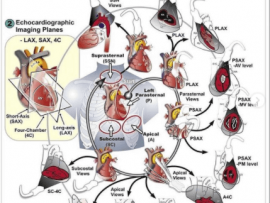
Mohammed Zidan, MBBCH, M.Sc Cardiology (Cardiology, Echocardiography and interventional Cardilogy Specialist at Al-Azhar university), Cairo, Egypt.
Read More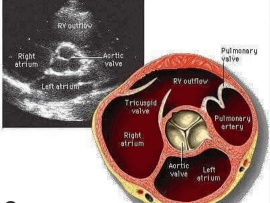
Beautiful illustrative picture about the parasternal short axis view, great vessel level Mohammed Zidan, MBBCH, M.Sc Cardiology (Cardiology, Echocardiography and interventional Cardilogy Specialist at Al-Azhar university), Cairo, Egypt...
Read More
Mitral Valve Leaflets and Scallops and its relation to Aortic Valve Sinuses Mohammed Zidan, MBBCH, M.Sc Cardiology (Cardiology, Echocardiography and interventional Cardilogy Specialist at Al-Azhar university), Cairo, Egypt...
Read More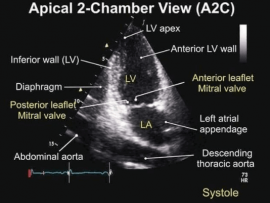
Mohammed Zidan, MBBCH, M.Sc Cardiology (Cardiology, Echocardiography and interventional Cardilogy Specialist at Al-Azhar university), Cairo, Egypt.
Read More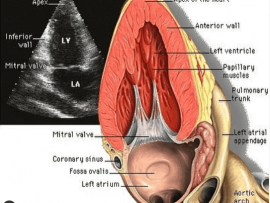
Apical 2 chamber view Importance: 1)Assessment of Ischemia “RWMAs” 2)Viewing LV apical thrombus 3)Assessment of MR and its mechanism 4)Assessment of pericardial effusion 5)viewing Coronary sinus and LAA ..
Read More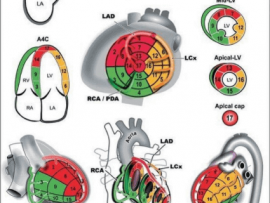
Different Echo views “A4C,A2C,PLAX and PSX” with the corresponding segment and its feeding vessel Mohammed Zidan, MBBCH, M.Sc Cardiology (Cardiology, Echocardiography and interventional Cardilogy Specialist at Al-Azhar..
Read More
Mohammed Zidan, MBBCH, M.Sc Cardiology (Cardiology, Echocardiography and interventional Cardilogy Specialist at Al-Azhar university), Cairo, Egypt.
Read More
Mohammed Zidan, MBBCH, M.Sc Cardiology (Cardiology, Echocardiography and interventional Cardilogy Specialist at Al-Azhar university), Cairo, Egypt.
Read More
Mohammed Zidan, MBBCH, M.Sc Cardiology (Cardiology, Echocardiography and interventional Cardilogy Specialist at Al-Azhar university), Cairo, Egypt.
Read More
Modified Simpson method (biplane method of disks) is a modality requiring area tracings of LV cavity. The American Society of Echocardiography recommends this method for measuring LVEF. This method requires..
Read More