


[gallery ids="12953,12956,12959"]
Read More
A 62-year-old man was admitted to our hospital with worsening heart failure. Three months prior to this hospitalization, he had been admitted to another local hospital with de novo heart failure. Transthoracic..
Read More
Dextro-transposition of the great arteries (D-TGA) has undergone a significant evolution in surgical repair, leading to survivors with vastly different postsurgical anatomy which in turn guides their long-term cardiovascular morbidity..
Read More
Abstract Background Echocardiographic measures of elevated left ventricular filling pressures are associated with an adverse prognosis. The aim of this study was to determine the relationship between acute (ratio of..
Read More
Mono cusp Pulmonary valve technique in Pulmonary Atresia [gallery ids="12916,12919"] Mohamed Gibreel , FEBR (Fellowship of Egyptian Board of Radiology ) Cardiac imaging consultant at Aswan heart center..
Read More
Scimitar sign ,,, Female in the fifth decade with : PAPVD of the right PVs to the IVC then RA. The left PVs drain normally to LA. [gallery ids="12909,12912"]..
Read More
26 Y male post TOF repair with "Double Barrel RVOT technique" Native RVOT stenosis,,, RV to PA conduit which shows diffuse degenerative changes , calcifications and filling defects ,,,, Exclude..
Read More
The Vanderbilt Faculty team will discuss Single ventricle physiology and how this affects perfusion technique during surgical correction. Our Journal Club explores alternative techniques to long acting cardioplegia..
Read More

[gallery ids="12819,12816"]
Read More


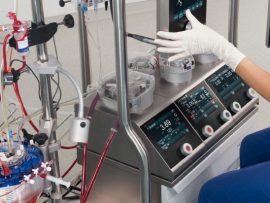
Abstract Background in adult cardiac surgery is commonly achieved with either multidose blood or single-dose del Nido crystalloid cardioplegia. Aim The aim of this systematic review and meta-analysis was to compare..
Read More
Abstract Background (ARDS) is a type of syndrome characterised by severe respiratory distress and stubborn . Patients with ARDS have a prolonged hospital stay and high mortality rate. Over long-term follow-up, ARDS..
Read More
Abstract Cardiopulmonary bypass (CPB) is required for the surgical correction of congenital heart defects and incites an acute inflammatory response that impairs endothelial function post-operatively. Therefore, we hypothesized that the..
Read More
Abstract Objective: Acute kidney injury (AKI) is a major complication after cardiovascular surgery. The unclear etiology of this highly complex event challenges definition, diagnosis and prediction of AKI, and hence..
Read More
Abstract Baseline cerebral regional saturation (rSO2) measured using the INVOS 5100C (Medtronic, MN, USA) varies widely among patients with cardiac and/or renal diseases. To identify significant correlates of baseline rSO2 and..
Read More
Abstract The rationale for mechanical circulatory support (MCS) in cardiogenic shock is to restore cardiac output in selected patients when critically low or in case of refractory cardiac arrest. Furthermore,..
Read More
Abstract Objectives: To assess differences in cognitive outcomes and sleep in adult survivors of critical illness, managed with venovenous extracorporeal membrane oxygenation as compared to conventional mechanical ventilation only. Design:..
Read More
Abstract Background and Objective Simulation in may help clinicians understand the important events occurring during and . During the COVID-19 pandemic, a significant number of patients have required hospital admission to tertiary referral..
Read More
Abstract Antiphospholipid syndrome (APS) is an acquired autoimmune condition characterized by the presence of antiphospholipid antibodies (lupus anticoagulant, anticardiolipin antibody, and anti-β2 glycoprotein-I antibody) which leads to clinical thrombosis via a..
Read More
Abstract Introduction: Extracorporeal membrane oxygenation circuit performance can be compromised by oxygenator thrombosis. Stagnant blood flow in the oxygenator can increase the risk of thrombus formation. To minimize thrombogenic potential,..
Read More
Mohammed Zidan, MBBCH, M.Sc Cardiology (Cardiology, Echocardiography and interventional Cardilogy Specialist at Al-Azhar university), Cairo, Egypt.
Read More
Large cystic RA mass Mohammed Zidan, MBBCH, M.Sc Cardiology (Cardiology, Echocardiography and interventional Cardilogy Specialist at Al-Azhar university), Cairo, Egypt.
Read More
1. Modified 4chamver view due to all cardiac chamber dilation. 2. Huge LA due to sever mitral stenosis. 3. Sever rheumatic mitral stenosis with diastolic AML doaming. 4. Sever LA..
Read More
Severe Mitral Stenosis and Moderate Aortic Regurgitation Mohammed Zidan, MBBCH, M.Sc Cardiology (Cardiology, Echocardiography and interventional Cardilogy Specialist at Al-Azhar university), Cairo, Egypt.
Read More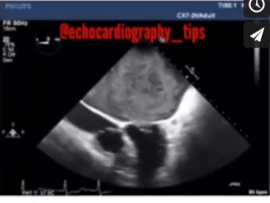
TEE shows Hugely dilated Left Atrium as a consequence of Rhematic Severe Mitral Stenosis, spontaneous Echo Contrast Grade IV “pre thrombus formation “ Mohammed Zidan, MBBCH, M.Sc Cardiology (Cardiology,..
Read More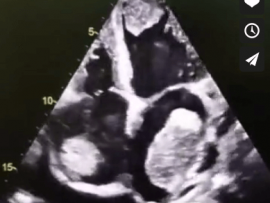
45 years old female patient with congestive Heart Failure “EF=22%” and history of stroke , the Echocardiography shows multiple big thrombi in the Heart chambers and moderate pericardial effusion ..
Read More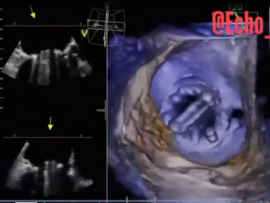
Severe Mitral Stenosis and Moderate Aortic Regurgitation Mohammed Zidan, MBBCH, M.Sc Cardiology (Cardiology, Echocardiography and interventional Cardilogy Specialist at Al-Azhar university), Cairo, Egypt.
Read More