
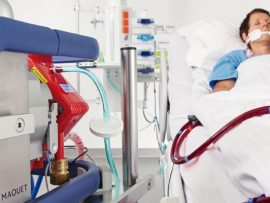

Abstract Purpose Previous studies support the potential efficacy of venovenous extracorporeal membrane oxygenation (vvECMO) for improving survival in severe acute respiratory distress syndrome (ARDS) cases. Prone positioning (PP) has been..
Read More
Abstract Purpose Percutaneous cannulation is increasingly used for veno-arterial extracorporeal membrane oxygenation (VA-ECMO). However, there is limited evidence about the benefit of this approach compared with conventional surgical cannulation. By..
Read More
Abstract Objectives: To investigate platelet pathophysiology associated with pediatric extracorporeal membrane oxygenation (ECMO). Design: Prospective observational study of neonatal and pediatric ECMO patients from September 1, 2016, to December 31,..
Read More
Abstract Veno-arterial extracorporeal membrane oxygenation (VA-ECMO) is used as mechanical circulatory support in cardiogenic shock (CS). It restores peripheral perfusion, at the expense of increased left ventricle (LV) afterload. In..
Read More
Abstract Background. Temporary extracorporeal membrane oxygenation (ECMO) support for high-risk percutaneous coronary intervention (PCI) has been described in select patients, and data are limited on the CardioHELP device (Maquet). The..
Read More
Abstract Background During peripheral extracorporeal veno-arterial membrane oxygenation (VA-ECMO) support, subclavian arterial cannulation provides, in comparison to femoral arterial cannulation, an anterograde flow which may prevent from left ventricular (LV)..
Read More
Abstract Purpose Achieving effective anticoagulation during neonatal extracorporeal membrane oxygenation (ECMO) without increasing the risk of hemorrhage remains challenging. The use of antithrombin III (AT-III) for this purpose has been..
Read More
Abstract Introduction Unfractionated heparin is widely used as an anticoagulant for extracorporeal life support (ECLS) and usually monitored with activated partial thromboplastin time (aPTT). Due to its limitations in pediatric..
Read More
Abstract Background:Patients with cardiogenic shock due to acute myocardial infarction (AMI) can rapidly undergo veno-arterial extracorporeal membrane oxygenation (VA-ECMO) therapy to recover cardiac output and decrease mortality. However, the clinical..
Read More
Abstract Metabolism management plays an essential role in extracorporeal technologies. There are different metabolic management devices integrated to extracorporeal devices; the most commonly used and accepted metabolic target in adult..
Read More
Abstract Objectives The aim of this study was to quantify and understand the unloading effect of percutaneous balloon atrial septostomy (BAS) in acute (CS) treated with venoarterial (VA) membranous oxygenation (ECMO). Background..
Read More
Abstract Patients with pulmonary hypertension and end-stage lung disease are fraught with high mortality while on a waiting list for lung transplant. With sometimes rapid deterioration they may require veno-arterial..
Read More
Abstract Objectives: To describe the use of extracorporeal membrane oxygenation (ECMO) in the management of pediatric poisoning in the United States and to identify predictors of mortality. Design: Retrospective cohort study. Setting: ..
Read More
History of extracorporeal membrane oxygenation is the ability to supplement native pulmonary and/or cardiac function in the setting of native system failure. Development of modern life support devices began with the..
Read More
Abstract Fluid overload in acute respiratory distress syndrome is associated with increased mortality. The purpose of this study was to investigate the association of cumulative fluid balance (CFB) during the..
Read More
Abstract Extracorporeal membrane oxygenation (ECMO) is a form of cardiopulmonary support primarily used in cardiothoracic and intensive care unit (ICU) settings. The purpose of this review is to familiarise radiologists..
Read More
Abstract Background management during venoarterial (ECMO) is particularly difficult in postcardiotomy shock patients given a significant bleeding risk. We sought to determine the effect of treatment on bleeding and thrombosis risk for..
Read More
Abstract Background The Center for Medicare and Medicaid Services decreased reimbursement rates for peripheral venoarterial (VA) (ECMO) and venovenous (VV) ECMO procedures in October 2018. Limited data are available describing hospital..
Read More
Abstract Extracorporeal membrane oxygenation (ECMO) is an advanced, resource-intensive form of life support for patients with severe respiratory or cardiac failure, and is typically provided within specialized centers. Prior to..
Read More
Abstract Background: Peripheral veno-arterial extracorporeal membrane oxygenation (V-A ECMO) is used to support circulatory failure refractory to conventional therapy. However, data on the heart-ECMO interaction at different levels of ECMO..
Read More
Abstract While extracorporeal support of patients awaiting pulmonary transplantation is now well-established, extracorporeal membrane oxygenation (ECMO) remains a nondurable technology deployed for short-term support or recovery in patients with progressive..
Read More
Abstract Background Within the past ten years, continuous-flow Left Ventricular Assist Devices (LVADS) have replaced pulsatile-flow LVADs as the standard of care for both destination therapy and bridging patients to..
Read More
Abstract Cardiogenic shock is associated with high mortality. Patients often require temporary mechanical circulatory support. We aimed to develop a percutaneously implantable, assist device that unloads the left ventricle (LV)..
Read More
Abstract Introduction Mechanical circulatory support (MCS) devices are increasingly used as a treatment option in resuscitation or in patients with cardiogenic shock (CS). Prophylactic implantation in high-risk percutaneous coronary interventions..
Read More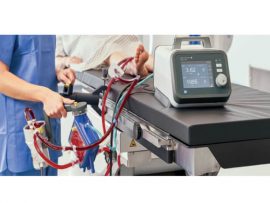
Abstract Background Chronic obstructive pulmonary disease, cystic fibrosis and usual interstitial pneumonia are three most common indications for lung transplantation (LuTx) in Poland. As a result of irreversible destruction of..
Read More
Abstract Objective Venoarterial is a rescue therapy for patients in . We hypothesize that patients bridged to with extracorporeal membrane oxygenation have decreased survival. Methods The United Network of Organ Sharing database was..
Read More
Abstract Respiratory failure and systemic inflammation are paramount features of severe SARS-CoV-2 disease (COVID-19). Extracorporeal membrane oxygenation (ECMO) therapy has a potential role in patients with refractory disease. An inflammatory..
Read More
Abstract Background Chronic thromboembolic pulmonary hypertension (CTEPH) is optimally treated by pulmonary thromboendarterectomy (PEA). Treatment effectiveness has been evaluated principally using single-center series. Data from the Society of Thoracic Surgeons..
Read More
Abstract The contribution of veno-venous (VV) extracorporeal membrane oxygenation (ECMO) to systemic oxygen delivery is determined by the ratio of total extracorporeal blood flow (Q˙EC) to cardiac output (Q˙). Thermodilution-based..
Read More
Abstract Critically ill patients requiring catecholamine infusion may require extracorporeal membrane oxygenation (ECMO) support. Initiating ECMO support may affect the circulating catecholamine levels, which directly influences the circulatory support. We..
Read More