
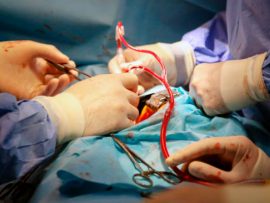

Abstract Background: Drainage cannulae extract blood from a patient during venoarterial extracorporeal membrane oxygenation (VA ECMO), a treatment that temporarily supports patients undergoing severe heart and/or lung dysfunction. Currently, the..
Read More
Abstract Background: Impaired cerebral autoregulation (CA) is one of several proposed mechanisms of acute brain injury in patients supported by extracorporeal membrane oxygenation (ECMO). The primary aim of this study..
Read More
Introduction Extracorporeal membrane oxygenation (ECMO) is increasingly used for circulatory or pulmonary support not only in-hospital but also out-of-hospital. Small dimensions and a lightweight design are important, especially for out-of-hospital..
Read More
Abstract Technical advances in extracorporeal membrane oxygenation (ECMO) have increased the number of cases that maintain longer duration. Long-term use of ECMO results in ECMO-related complications. Anticipation of the life-threatening..
Read More
Abstract For single-lumen veno-pulmonary extracorporeal membrane oxygenation (VP ECMO) cannulation in percutaneous technique, vascular ultrasound (U/S) and transesophageal echocardiography (TEE) guidance were used to insert a 7 Fr pulmonary artery..
Read More
Abstract I read with keen interest the article by van Minnen et al. on contemporary mechanical ventilation strategies during extracorporeal membrane oxygenation (ECMO). The article specifies details on ventilation practices employed in..
Read More
Abstract Extracorporeal membrane oxygenation (ECMO) is a temporary lifesaving treatment for critically ill patients with severe respiratory or cardiac failure. Studies demonstrated the feasibility of in-hospital mobilizing during and after..
Read More
Abstract Cardiogenic shock (CS) is a complex and life‐threatening condition characterized by a sudden and profound reduction in cardiac output, leading to inadequate tissue perfusion and oxygen delivery and organ..
Read More
Abstract National trends show rapid increases in the use of mechanical circulatory support devices (MCSD) over the last 20 years. While current literature has not proven a mortality benefit in..
Read More
Abstract Purpose: Venoarterial extracorporeal membrane oxygenation (V-A ECMO) can be used to support severely ill patients with cardiogenic shock. While age is commonly used in patient selection, little is known..
Read More
Abstract There has been an increase in the use of extracorporeal membrane oxygenation (ECMO) to bridge critically ill patients to lung transplant (LTX). This study evaluates how ambulatory status on..
Read More
Abstract Left ventricular (LV) unloading has been shown to improve survival for patients requiring veno-arterial extracorporeal membrane oxygenation (VA ECMO) support for cardiogenic shock. A mortality benefit has been shown..
Read More
Abstract Background and objective: Extracorporeal membrane oxygenation (ECMO) has been successfully and widely used in adult patients for the past 5 years. About 50% of these patients can survive and are..
Read More
Abstract Background This study aims to improve nursing students’ ability to care for critically ill patients through education in extracorporeal membrane oxygenation (ECMO) nursing. Methods This study developed a virtual..
Read More
Abstract Background Patient temperature during extracorporeal membrane oxygenation (ECMO) is commonly managed by dedicated heating units (HUs) that are integrated into ECMO circuitry. Currently, no HU has received approval for..
Read More
Abstract Background There is considerable debate about the hemodynamic effects of veno-arterial extracorporeal membrane oxygenation (VA-ECMO). Aims To evaluate the changes in left ventricular (LV) function, volumes, and work in..
Read More
Abstract Background Venoarterial extracorporeal membrane oxygenation (ECMO) provides full hemodynamic support for patients with cardiogenic shock, but optimal timing of ECMO initiation remains uncertain. We sought to determine whether earlier..
Read More
Abstract Refractory hypoxemia (RH) during venovenous extracorporeal membrane oxygenation (VV ECMO) support is a complex problem that limits the benefit of this therapy. The need for sustained deep sedation and..
Read More
Abstract Extracorporeal membrane oxygenation (ECMO) is an invasive life support technique that requires a blood pump, an artificial membrane lung, and vascular cannulae to drain de-oxygenated blood, remove carbon dioxide,..
Read More
Abstract Peripheral venoarterial extracorporeal membrane oxygenation (VA-ECMO) is increasingly being used in patients suffering from refractory cardiogenic shock (CS). Although considered life-saving, peripheral VA-ECMO may also be responsible for intracardiac..
Read More
Abstract Objective: The number of out-of-hospital cardiac arrest (OHCA) patients who may benefit from prehospital extracorporeal cardiopulmonary resuscitation (ECPR) is yet to be elucidated. Patient eligibility is determined both by case..
Read More
Abstract Bilevel-positive airway pressure (BiPAP) is a noninvasive respiratory support modality which reduces effort in patients with respiratory failure. However, it may increase tidal ventilation and transpulmonary pressure, potentially aggravating..
Read More
Abstract Long-term neuropsychiatric symptoms as well as neurologic and functional impairment are common in patients who receive extracorporeal membrane oxygenation (ECMO) support, results of a new meta-analysis showed. More than..
Read More
Abstract Introduction Thrombophilic disorders increase the risk of blood and are associated with morbidity in various settings. However, the impact of on ECMO (Extracorporeal membrane oxygenation) patients is not well studied. We..
Read More
Abstract Background: Impaired cerebral autoregulation (CA) is one of several proposed mechanisms of acute brain injury in patients supported by extracorporeal membrane oxygenation (ECMO). The primary aim of this study was..
Read More
Abstract Introduction The objective of this study was to investigate the potential synergistic utility of a combination of gaseous nitric oxide (gNO)-intravenous Cangrelor as an effective pharmacological option for the..
Read More
Abstract Objectives is a potentially life-threatening complication during (ECMO). In this study, we assessed the incidence, , and risk factors for mortality of cardiac tamponade during ECMO. Design We queried the Organization (ELSO)..
Read More
Abstract Background Veno-arterial extracorporeal membrane oxygenation (VA-ECMO) can be initiated during cardiac surgery or later in ICU according to the hemodynamic profile and organ perfusion. Our aim was to study..
Read More
Abstract Purpose: Cardiogenic shock is associated with high mortality. In refractory shock, it is unclear if mechanical circulatory support (MCS) devices improve survival. We conducted a network meta-analysis to determine..
Read More
Abstract Extracorporeal membrane oxygenation (ECMO) supplies circulatory support and gas exchange to critically ill patients. Despite the use of systemic anticoagulation, blood exposure to ECMO surfaces causes thromboembolism complications. Inhibition..
Read More