
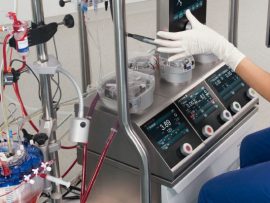

Abstract Background. To decrease the complications associated with cardiopulmonary bypass, novel biomaterials have been introduced that may be less thrombogenic than standard synthetic surfaces. Methods. Thirty-four patients undergoing coronary..
Read More
Take Home Points: modified Dixon (mDixon) 3D cardiovascular magnetic resonance angiography (CMRA) demonstrates reduced artefact burden and better delineation of head and neck vessels as well as pulmonary veins compared..
Read More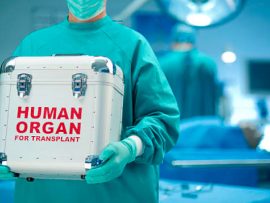
De battre le cœur a continué. Le 26 mars 2021, les équipes de chirurgie cardiaque et d’anesthésie-réanimation du CHU de Rennes ont réalisé une transplantation cardiaque d’un genre nouveau..
Read More
Abstract We present a dissection of the patent ductus arteriosus and pulmonary artery for surgical repair utilising cardiopulmonary bypass in the setting of vein of Galen malformation. Several strategies were..
Read More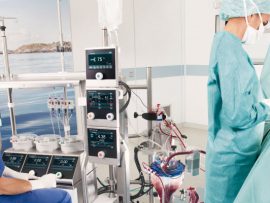
Abstract The wet priming of extracorporeal membrane oxygenation systems and storage of these systems for rapid deployment is common practice in many clinical centers. This storage policy is, however, seen..
Read More
Abstract Background The utilization of venoarterial extracorporeal membrane oxygenation (VA‐ECMO) as a life‐supporting therapy has increased exponentially over the last decade. As more patients receive and survive ECMO, there are..
Read More
Abstract Postoperative neurologic complications have a significant effect on morbidity, mortality, and long-term disability in patients undergoing cardiac surgery. The etiology of brain injury in patients undergoing cardiac surgery is..
Read More
Abstract Both antiviral treatment with remdesivir and hemoadsorption using a CytoSorb® adsorption device are applied in the treatment of severe COVID‐19. The CytoSorb® adsorber consists of porous polymer beads that adsorb a..
Read More
Abstract Background: Thromboembolism and bleeding contribute to Coronavirus disease 2019 (COVID-19)’s morbidity and mortality and are also frequent complications of venovenous extracorporeal membrane oxygenation (vvECMO). As the interaction of the..
Read More
Abstract Background: Monitoring oxygen delivery to the oxygenator of a heart lung machine (HLM) is typically accomplished with an O2 analyzer connected to the gas inflow line. It is assumed when..
Read More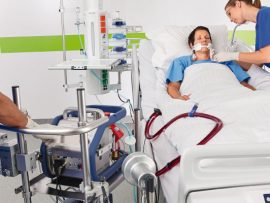
Abstract Extracorporeal membrane oxygenation (ECMO) bridge to lung transplantation (LuTX) exposes the patients to a high risk of perioperative bleeding secondary to systemic anticoagulation and coagulation factors deficiency. With this..
Read More
Abstract Background Early studies conclude patients with Covid-19 have a high risk of death, but no studies specifically explore cardiac surgery outcome. We investigate UK cardiac surgery outcomes during the..
Read More
Abstract Objectives To evaluate recent practice and outcomes of reoperative cardiac surgery via re-sternotomy. Use of early versus late institution of cardiopulmonary bypass (CPB) before sternal re-entry was of particular..
Read More
Abstract Objective Failure of membrane oxygenator (MO) function of venovenous extracorporeal membrane oxygenators (VV ECMO) remains problematic. The development of device-induced coagulation disorder (COD) or worsened gas transfer (WGT) necessitates..
Read More
Abstract Objectives Kidney Disease: Improving Global Outcomes (KDIGO) guidelines include assessment of creatinine and urine output to identify acute kidney injury (AKI). Whether urine output is an accurate indicator of..
Read More
Abstract Background Single- (SL) and double-lumen (DL) catheters are used in clinical practice for veno-venous extracorporeal membrane oxygenation (V-V ECMO) therapy. However, information is lacking regarding the effects of the..
Read More
Abstract Background Early hypercapnia is common in patients with acute respiratory distress syndrome (ARDS) and is associated with increased mortality. Fluctuations of carbon dioxide have been associated with adverse neurological..
Read More
Abstract OBJECTIVES: Monitoring cerebral autoregulation may help identify the lower limit of autoregulation in individual patients. Mean arterial blood pressure below lower limit of autoregulation appears to be a risk..
Read More
Abstract Background Atrial flutter (AFL) is a supraventricular tachyarrhythmia. In the ECG tracing, it is marked by a fast, irregular atrial activity of 280–500 beats per minute. AFL is known..
Read More
Abstract Type A aortic dissection most often requires emergent surgery to prevent malperfusion, stroke, and/or rupture of aorta. To achieve the structural goals of the operation, the conduct of the..
Read More
Abstract Objective To determine the predictors of postoperative acute kidney injury (AKI) following nonemergent cardiac surgery among patients with variable preoperative estimated glomerular filtration rate (eGFR) levels. Methods A retrospective..
Read More
Abstract Background Hemorrhagic events remain a major concern in patients under extracorporeal membrane oxygenation (ECMO) support. We tested the association between anticoagulation levels and hemorrhagic events under ECMO using anti-Xa..
Read More
Abstract OBJECTIVES Hearts donated after circulatory determination of death are usually preserved with normothermic machine perfusion prior to transplantation. This type of preservation is costly, requires bench time adding to..
Read More
Abstract Background: To report and compare the characteristics and outcomes of COVID-19 patients on extracorporeal membrane oxygenation (ECMO) to non-COVID-19 acute respiratory distress syndrome (ARDS) patients on ECMO. Methods: We..
Read More
Abstract Cardiopulmonary bypass (CPB) is very commonly performed among the cardiovascular surgeries, and delayed recovery (DR) is a kind of serious complications in patients with CPB. It is necessary to..
Read More
Abstract UNLABELLED:Hemodilution during cardiopulmonary bypass (CPB) is a primary risk factor for blood transfusion in cardiac surgical patients. Priming of the CPB circuit with the patients' own blood (retrograde autologous..
Read More
Abstract Vasoplegic syndrome is a common occurrence following cardiothoracic surgery and is characterized as a high-output shock state with poor systemic vascular resistance. The pathophysiology is complex and includes dysregulation..
Read More
Abstract The current practice of cardiopulmonary bypass (CPB) requires a preoperative priming of the circuit that is frequently performed with crystalloid solutions. Crystalloid priming avoids massive embolism but is unable..
Read More
Summary The COVID-19 pandemic strained health-care systems throughout the world. For some, available medical resources could not meet the increased demand and rationing was ultimately required. Hospitals and governments often..
Read More
The COVID-19 pandemic has raised challenging questions about the rationing of intensive care unit (ICU) beds, mechanical ventilators, and extracorporeal membrane oxygenation (ECMO). Experts have recommended that ECMO be..
Read More