
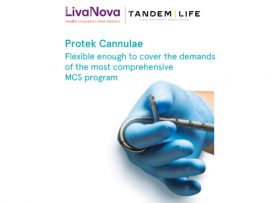

Abstract Venovenous extracorporeal membrane oxygenation (ECMO) can be performed with two single lumen cannulas (SLCs) or one dual-lumen cannula (DLC) where low recirculation fraction (Rf) is a key performance criterion...
Read More
Abstract A neonate with pulmonary hypertension was supported with extracorporeal membrane oxygenation (ECMO). During ECMO support, the patient developed Enterococcus faecalis bacteremia, treated with targeted antibiotics. Despite the maximum dose of antibiotics, routine blood..
Read More
Abstract Cardiac donation after circulatory death (DCD) with ex-vivo perfusion (EVP) has the potential to greatly increase the donor pool, a benefit that can extend to selected pediatric patients. We..
Read More
Abstract Cardiac arrest affects approximately 600 000 people in the US yearly and is associated with a survival rate of 10% to 12% for out-of-hospital cardiac arrests and 25% to 30%..
Read More
Abstract Background Although outcomes of patients after cardiac arrest remain poor, studies have suggested that extracorporeal cardiopulmonary resuscitation (ECPR) might improve survival and neurological outcomes. We aimed to investigate any..
Read More
Abstract The use of veno- arterial extracorporeal membrane oxygenation as extracorporeal cardiopulmonary resuscitation in patients suffering out- of- hospital cardiac ar-rest, largely increased in the last decade despite evidence supporting..
Read More
Abstract Our primary objective was to identify if fasciotomy was associated with increased mortality in patients who developed acute compartment syndrome (ACS) on extracorporeal cardiopulmonary resuscitation (ECPR). Additionally, we sought to identify any additional risk factors..
Read More
Abstract Objectives Extracorporeal cardiopulmonary resuscitation (eCPR) is increasingly used due to its beneficial outcomes and results compared to conventional CPR. After cardiac arrest, the overall ejection fraction is severely impaired;..
Read More
Abstract Background Cerebral protection strategies during proximal remains controversial due to lack of evidence and large patient . We herein evaluated our 3-decade experience using hypothermic circulatory arrest with retrograde (DHCA/RCP) to evaluate..
Read More
Abstract Objectives Previous studies have described impaired after (CPB). Whether this is still valid in contemporary cardiac surgery is unclear. This study aimed to quantify changes in function and number of platelets..
Read More
Abstract This review aims to survey the current state of mechanotransduction in vascular smooth muscle cells (VSMCs) and endothelial cells (ECs), including their sensing of mechanical stimuli and transduction of..
Read More
Abstract Bleeding is a leading cause of perioperative mortality []. In a perioperative setting, damage control surgery with massive transfusion protocols (MTPs) are therapeutic approaches used clinically to manage patients..
Read More
Abstract We aimed to describe the clinical outcomes of veno-arterial extracorporeal membrane oxygenation (VA-ECMO) therapy in our institution considering clinical context and pH at cannulation. All patients treated by VA-ECMO during the..
Read More
Abstract The use of veno-arterial extracorporeal membrane oxygenation as extracorporeal cardiopulmonary resuscitation in patients suffering out-of-hospital cardiac arrest, largely increased in the last decade despite evidence supporting this practice being..
Read More
Abstract OBJECTIVES: Near-infrared spectroscopy (NIRS) has been increasingly accepted as a noninvasive marker of regional tissue oxygenation despite concerns of imprecision and wide limits of agreement (LOA) with invasive oximetry. New generation absolute..
Read More
Abstract Background: Physical therapy (PT) utilization in patients requiring mechanical circulatory support (MCS) and extracorporeal membrane oxygenation (ECMO) has been reported; however, little is known about intensive rehabilitation and associated..
Read More
Abstract Objective This study was aimed to elucidate the effect of the intraoperative cell saver (CS) on hyperlactatemia of patients who underwent cardiac surgery. Design A sub-analysis of the CS..
Read More
Abstract Obtaining arterial access for cardiac catheterization can be both challenging and morbid in patients supported by venoarterial extracorporeal membrane oxygenation (VA-ECMO). While catheterization performed by obtaining endovascular access through..
Read More
Abstract Artificial lung membrane as extracorporeal blood-gas barriers could execute similar functions as human alveoli, whereby accomplish blood gas exchange process, providing imperative life support for patients with cardiopulmonary failure...
Read More
Abstract Background Postoperative pulmonary complications increase mortality after cardiac surgery. Conventional ultrafiltration may reduce pulmonary complications by removing mediators of bypass-induced inflammation and countering hemodilution. We tested the primary hypothesis..
Read More
Abstract Acute kidney injury (AKI) is a frequent complication of cardiac surgery that contributes to postoperative morbidity and mortality. The timing of renal replacement therapy (RRT) remains unclear. The Artificial..
Read More
Abstract Many young adults require heart valve replacements. Current options for valve replacement in adults include mechanical valves, bioprosthetic valves, or the Ross procedure. Of these, mechanical and bioprosthetic valves..
Read More
Abstract Background Refractory out-of-hospital cardiac arrest (OHCA) treated with standard advanced cardiac life support (ACLS) has poor outcomes. Transport to hospital followed by in-hospital extracorporeal cardiopulmonary resuscitation (ECPR) initiation may..
Read More
Abstract Interhospital transport of acute respiratory distress syndrome (ARDS) patients bears transport-associated risks. It is unknown how interhospital extracorporeal membrane oxygenation (ECMO) transfer of COVID-19 patients by mobile ECMO units affects ARDS mortality. We compared the outcome..
Read More
Abstract Venlafaxine is a serotonin and noradrenalin reuptake inhibitor prescribed as an antidepressant. Overdose clinically manifests with neurological, cardiovascular and gastrointestinal abnormalities based on, amongst others, serotonin syndrome and can..
Read More
Abstract Membrane oxygenator failure during venovenous (V-V) extracorporeal membrane oxygenation (ECMO) can lead to life-threatening hypoxia, high replacement costs, and may be associated with a hyperfibrinolytic state and bleeding. The current understanding..
Read More
Abstract Refractory right ventricular failure has significant morbidity and mortality. Extracorporeal membrane oxygenation is indicated when medical interventions are deemed ineffective. However, it is still being determined if one configuration is better. We conducted..
Read More
Abstract Background Valve reintervention after transcatheter aortic valve replacement (TAVR) failure has not been studied in detail. Objectives The authors sought to determine outcomes of TAVR surgical explantation (TAVR-explant)..
Read More
Abstract Background Anaemia and blood transfusion are two independent contributing factors to perioperative morbidity in cardiac surgery. While preoperative treatment of anaemia has been shown to improve outcomes, in real..
Read More
Abstract Introduction Off-pump coronary artery bypass grafting (OPCABG) was introduced many years ago aiming to reduce the known complications of conventional on-pump coronary surgeries. Heparin is required during the procedures,..
Read More