
Aortopulmonary window
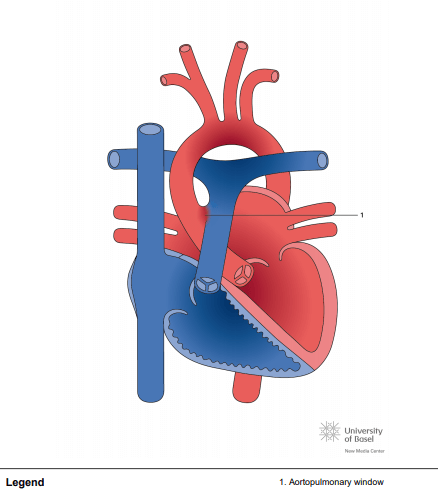

Aortopulmonary window (APW) or aortopulmonary septal defect, first described by Elliotson in third decade of last century,[1] is a cardiac abnormality that results from abnormal communication between the proximal aorta and the main pulmonary artery in the presence of two normally separated aortic and pulmonary valves. APW is a relatively rare cardiac lesion representing approximately 0.2% to 0.6% of all cardiac malformation.[2–4] APW could be isolated, but in half of patients, may be associated with other cardiac malformations. The most common associated malformations are arch abnormalities, specifically coarctation of the aorta, type A interruption of aortic arch, ASD, tetralogy of fallot, and aortic origin of the right pulmonary artery.[5] More rarely, it is associated with ventricular septal defect, pulmonary or aortic atresia, transposition of great arteries and tricuspid atresia.[6–9] APW can be classified into 3 types: proximal, distal and total defects.
Echo Parasternal short axis pulmonary artery
Echo Apical 4 chamber pulmonary valve